Monday, October 13, 2008

Roberta Bondi on the Desert Mothers and Fathers

I'm a regular listener of Krista Tippett's Speaking of Faith, and, as you know, a spiritual brother of the Desert Elders. On May 15, 200, Tippett interviewed three people of prayer, the third being Roberta Bondi, who shared her appreciation for the witness and life of the Desert Mothers and Fathers. I thought you might enjoy reading their conversation. Here's that part of the interview as published:

Ms. Tippett: I'm Krista Tippett, and this is Speaking of Faith from American Public Media. Today, "Approaching Prayer" in three very different traditions and lives.

(Music excerpt from "Veni Sancte Spiritus" from Chant, performed by The Benedictine Monks Santo Domingo de Silos)

Ms. Tippett: This is an eighth-century prayer in Latin, "Veni Sancte Spiritus," "Come, Holy Spirit," sung by the Spanish monks of Santo Domingo de Silos. Monastics, monks and nuns, pray ritually many times each day for the world, they say, for all the rest of us. And many in the West are increasingly drawn to ancient contemplative practices.

(Music excerpt from "Veni Sancte Spiritus" from Chant, performed by The Benedictine Monks Santo Domingo de Silos)

My next guest, theologian Roberta Bondi, is part of this movement. A professor emeritus at Emory University, she's written beloved, practical books about how she learned to pray when she discovered the writings of the earliest Christian monastics.

Prof. Bondi: Sometimes it seems when I'm talking to people about prayer that one of the main points I have to keep making over and over is there is no right way. The important thing is to find your way, and this was something that I learned from the Abbas and Ammas of the ancient desert.

Ms. Tippett: Abbas and Ammas were Christians from all walks of life who, around the fifth and sixth centuries, retreated from a church, which they felt had been corrupted by its own power. They went into the deserts of Egypt and Syria to pray. Politicians, generals, and peasants sought their advice on matters both spiritual and secular. Abba and Amma are Semitic words for father and mother, and their insights were collected by their followers and passed down across centuries as the sayings of the fathers and mothers. The theology of the desert transformed Roberta Bondi's image of God. The Abbas and Ammas imagined a God more understanding, more compassionate than human beings ever are towards each other or towards themselves. They were Christianity's first mystics and psychotherapists rolled into one. Their eccentric, earthy sayings changed Roberta Bondi's way of thinking about religion. Still, she held prayer itself at a scholarly distance until a crisis of confidence early in her marriage to her husband, Richard. One day, as often, he was late coming home.

Prof. Bondi: I was sitting there on the couch and all of a sudden the Abbas from the ancient desert started saying to me, "Roberta, Roberta, we have something to say to you," and I said, "Shut up and leave me alone. I'm worrying." And they said, "Oh, oh, no. Come on now. Come on. Listen." "Shh, shh, I'm worrying. Leave me alone." And finally I said, "All right. All right. What do you have to say?" And they said to me, "Well, now, you know that the main thing we're doing out here in the desert is prayer, and you have spent a lot of time studying us and working on us, and you might consider whether this might be something for you." And I said to them, "Oh, come on now. Look, I am a rational, reasonable woman, and I'm an academic, and this is, what you're suggesting, just is not really for me." And the answer to that was, "Ho, ho, ho, you might also consider as part of this that you have put Richard into the place of God for you. You know how we say that no one or no thing can fill that hole in your life except God, that your identity rests only in God and that all other loves come out of that, and that no human being can ever fill that. Of course you feel the way you do." So I was very embarrassed, because I knew, of course, instantly that they were right. So I said, "OK. All right. All right. I'll try it."

So, well, first, I let Richard come home and then yelled at him a little bit. And then I went out and got a book that had a pattern of prayer in it that was similar to what was used in the early church, and that was what started me on my discipline of prayer. And I can say several things that I learned out of that that I like to share with others, and one of the things is you don't need any kind of noble reason or highfalutin or serious reason. Any reason to begin a pattern of prayer is a good reason, because prayer is about everyday life. It isn't the great spiritual mystery that is too high and lofty for the likes of us.

Ms. Tippett: You often talk about the importance of just showing up for prayer.

Prof. Bondi: We often have a kind of notion as part of this highfalutin, noble picture of ourselves as prayers that when we pray we need to be completely attentive and we need to be fully engaged and we need to be concentrating and we need to be focused. But the fact is, if prayer is our end of a relationship with God, that's not the way we are with the people we love a large portion of the time. We simply are in their presence. We're going about our lives at the same time in each other's presence aware and sustained by each other, but not much more than that.

Ms. Tippett: Well, let me tell you a story about when I first started teaching in the seminary where I teach now. And I would just find when I came home at the end of the day I would be so exhausted that I could hardly contain myself. And I would be met at the car, usually, pulling into the driveway by my two children and my husband, who would all come out to tell me all the things that had gone wrong in the day, like the washing machine had overflowed and the rug in the dining room was soaking wet. And I would think, "Oh, I just want to go back to school." I would come into the house, and Richard and I would fix supper, and then we would sit down and eat and I would fall asleep with my head in the mashed potatoes. But the fact is that I knew all along that, however it was, it was better that I was there than that I wasn't there, that my family needed me, that being part of a family means showing up for meals. And prayer is like that. However we are, however we think we ought to be in prayer, the fact is we just need to show up and do the best we can do. It's like being in a family.

(Sound bite of music)

Ms. Tippett: Theologian Roberta Bondi. Here's a saying of the desert father Abba Zeno.

Reader: "If a man wants God to hear his prayer quickly, then before he prays for anything else, even his own soul, when he stands and stretches out his hands towards God, he must pray with all his heart for his enemies. Through this action, God will hear everything that he asks."

(Sound bite of music)

Prof. Bondi: You know, one of the Abbas was asked one time which was the most difficult virtue to acquire, and he went through the whole list of one virtue after another, and then he concluded by saying, "But prayer is the hardest of the virtues because prayer is warfare to the last breath." In prayer, we are likely, and it's certainly what we want, to see ourselves as we really are. We can't expect that we are going to be healed of the deep wounds of our heart without seeing what those wounds are. It's also not a peaceful activity when we discover or come face to face with the reality of the world.

Ms. Tippett: Talk about some of those images you find in scripture that it's all right for us to struggle and even fight with God and even nag and demand things that feel important to us.

Prof. Bondi: Well, one of my favorite images from scripture since the time I was a child was always Jacob wrestling with the angel.

(Sound bite of music)

Reader: "That same night Jacob arose and took his two wives and his two maids and his 11 children and crossed the ford at the Jabbok. He took them and sent them across the stream, and likewise everything that he had. And Jacob was left alone. And a man wrestled with him until the breaking of the day. When the man saw that he did not prevail against Jacob, he touched the hollow of his thigh, and Jacob's thigh was put out of joint as he wrestled with him. Then he said, 'Let me go, for the day is breaking.' But Jacob said, 'I will not let you go unless you bless me.' And he said to him, 'What is your name?' And he said, 'Jacob.' Then he said, 'Your name shall no more be called Jacob, but Israel, for you have striven with God and with man and have prevailed,' and there he blessed him."

Prof. Bondi: This is, I think, my very favorite because it has all the elements of real prayer: God sneaking up on Jacob, you know, because it's really God, this angel is, sneaking up on Jacob unexpectedly in the night, which is often when God comes to us with anxiety-producing information about ourselves or about our situation. Jacob's absolute persistence in saying, "Look, all right, you started this. I'm not letting you go." And his absolute, steadfast commitment to the fact that if he hung in there, there would be a blessing in it, which is my experience over and over and over. But wrestling is the way it is a lot of the time.
I have a friend who plays in the Atlanta Symphony, and someone asked him once what it was like to play piccolo in a great symphony like the Atlanta Symphony, and he said, "Well, it's actually long stretches of boredom interspersed with short periods of pure terror." And I wouldn't say it quite like that, that prayer is like that, but I would say that prayer is long periods of ordinary shared life together with intense periods of wrestling with really serious stuff that can scare us to death but can also bring us into real life with God and real life with ourselves in a way that we can't otherwise have it.

(Sound bite of music)

Ms. Tippett: Roberta Bondi is Professor Emeritus of Church History at the Candler School of Theology of Emory University. Her books include Memories of God and To Pray and to Love.
To end this hour, we have a reading on prayer taken from the writings of poet and memoirist Patricia Hampl.

Reader: What is prayer?
I make a list:
Praise
Gratitude
Begging/pleading/cutting deals
Fruitless whining and puling
Focus

There the list breaks off; I had found my word. Prayer only looks like an act of language; fundamentally it is a position, a placement of oneself. Focus. Get there, and all that's left to say is the words. They come: from ancient times (here, the round of Psalms, wheeling through the seasons endlessly in the Office), from the surprisingly eloquent heart (taciturn Thomas last night with his intercession, precise as a poet), from the gush and chatter of the day's detail longing to be rendered.

So what is silence?

Silence speaks, the contemplatives say. But really, I think, silence sorts. An ordering instinct sends people into the hush where the voice can be heard. This is the sorting intelligence of poetry, marked by the unbroken certainty of rhythm, perfect pitch, the placing of things in right order as in metrical form. Not rigid categories, but the recognition of a shape always there but ordinarily obscured by—what? By noise, which is ourselves trying to do the sorting in an order that may be a heroic effort but is bound to be a fantasy.

(Sound bite of music)

Getting Ready for the Twenty-third after Pentecost: October 19

Before Sunday, you may wish to visit Journey with Jesus where there's a guest essay on the upcoming lectionary readings by Adam Hamilton, the author of Seeing Gray in a World of Black and White and the upcoming Simplicity, Generosity and Joy. Hamilton is the Senior Pastor at the United Methodist Church of the Resurrection in Leawood, Kansas.

Friday, October 10, 2008

(2) From the Desert Abbas and Ammas: The Way God Loves Us

Here is a story that preserves a "saying" Abba Mius once made:

A soldier asked Abba Mius if God accepted repentance. After old Mius had taught the soldier many things, Mius said, "Tell me, my dear, if your cloak is torn, do you throw it away?" The soldier replied, "No, I mend it and use it again." Old Abba Mius said to him, "If you are so careful about your cloak, will not God be equally careful about his creature?" (The Sayings of the Desert Fathers, trans. Benedicta Ward. Kalamazooo, MI, 1984, 150; lightly edited)
What a wonderful story that underscores the spiritual wisdom of a Desert Father. I espeically like the manner in which Abba Mius addresses the lieutenent colonel with "My dear." Even those in power deserve to be addressed courteously. And just in case you don't quite get the full import of the tale, Roberta Bondi in To Pray and Love: Conversations on Prayer with the Early Church provides this short commentary:

Sin does not destroy God's love and yearning for us. Sometimes it is said that the real wonder of our faith is that God loves us in spite of our unloveableness. Our monastic ancestors would find such a way of speaking quite alien. To God we are lovable and valuable, however damaged we may be. God's love is always there whether or not we can feel it, whether we seem good or bad to ourselves or to others, or whether or not we respond to God. It is a love that does not depend on our "being good."

A few days ago I mended with some glue an old sandal whose strap had broken loose. Now when I wear it out in the workshop, Abba Mius reminds me that as the repaired shoe is to me so I am to God: I am God's Andrew whom He made, "knit," and fashioned in my mother's womb, whom in Holy Baptism He claimed as his own, and whom He repairs and fixes me up when my life gets frayed, broken, and torn. God loves an old shoe like me. He glues me back together.

Wednesday, October 08, 2008

(1) From the Desert Abbas and Ammas: The Tired Brother or Sister

Inasmuch as I've often recommended reading what the early church's Abbas and Ammas have left by way of recommendation for authentic living, during the next several months I'll post now and then a "word" from the Desert Fathers. Here's the first I've chosen, one that is typical, indicative of the creative way they suggest that life in Christ might well be lived among us:

Some old men came to see Abba Poemen and said to him, "When we see brothers who are dozing at the synaxis [a liturgical office said by the monks together], shall we rouse them so that they will be watchful? He said to them, "For my part when I see a brother who is dozing, I put his lead on my knees and let him rest." (The Sayings of the Desert Fathers: The Alphabetical Collection, trans. Benedicta Ward (Kalamazoo, MI: Cistercian Publications, 1975), 179-80.


Now that's delightful, not only because I sometimes doze off during worship when the sermons are particularly dull, but also--and more importantly!--because this "word" from Abba Poemen nicely hints at the empathetic and compassionate understanding Abba Poemen encourages us to nurture as we live with others. So the next time you see my head bobbing as I try to stay awake, do support me in some way other than elbowing me to jolt me out of my drowsiness. I'll do that same for you; after all, you may have experienced a sleepless night, and especially hard day at work, or some an exhausting labor of love . So lean your head on my shoulder and rest.

The implications of Poemen's saying, his "word," are enormous. More of the sayings will be coming soon.


Preparing for the 22nd Sunday after Pentecost, October 12

Daniel B. Clendenin at Journey with Jesus has emailed the following:

JwJ Readers, click here for our home page: http://www.journeywithjesus.net/.

David Werther has a new music review of "Insomniaaccomplishments" by Jonathan Rundman.

My essay considers militarism as a new form of idolatry, "Aaron and the Gods of Gold."

For film I review "The Band's Visit" (excellent!), and a fine book well worth reading, "Seeing Gray in a World of Black and White" by Adam Hamilton. Hamilton argues for a "radical center" that moves beyond tired debates between liberals and conservatives.

And for poetry, John Wesley's marvelous "Covenant Prayer."
For the Sundays following October 12, Dan also provides these announcements:

10/19: Adam Hamilton of UMC Church of the Resurrection on faith and politics

10/26: Humanizing Holiness: Are Some Commandments More Important Than
Others?

11/02: Celebrating the Saints: All Saints Day

Saturday, October 04, 2008

October 4: St. Francis

Yesterday I got ready for today, St. Francis day, by cleaning out the summer's bird houses (I'll give several of them a new coat of paint this winter), tidying up the feeders, and making sure the bird baths are clean and filled with fresh water. This morning I sat outside to listen to the bird choir, and later on today I hope to buy some sun flower seeds, large enough as not to slip through the wire mesh bottom I installed in the new feeder I built yesterday. I'll try to get some striped seeds; they're usually quite large. Then too I want to make some suet cakes so that I'll have some when winter really comes along and the titmice, cardinals, woodpeckers, chickadees, sparrows, finches, and other assorted guests need for high-protein energy.

As you might imagine, I like to wake up with the birds. If you'd like to see what such waking is like, visit the posting I made this morning at The Attentive Life. In the meantime, have a blessed St. Francis Day.

Thursday, October 02, 2008

St. Francis

Although today is Thursday, I had occasion early this morning to remember that Saturday will be the Feast of St. Francis of Assisi. For whatever reason my internal alert (the word alarm does quite fit, does it?) clock went off a little later than usual today, and I entered the morning Quiet about a half hour later than usual, a bit before dawn. As I sat in the morning chill, sometime near the end of Centering Prayer, a flock of Canadian geese flew across the sky, somewhere in the west, heading south. Their honking startled a bit, but as the sound of their pilgrimage lessened and eventually disappeared, I asked God to bless them on their journey, and then went back into the Quiet. Later, while making coffee (I like the strong stuff, Haitian roasted, ground the night before, steeped in very hot water in a French press), it dawned on me that two mornings from now I will be in St. Francis Day, one of my favorites.

God has given me the grace to like animals, all sorts of them: dogs, cats, turtles, horses, fish, snakes. But especially birds. And decades ago when I discovered that St. Francis was a birder, he immediately got high rankings. If like me, you're attracted to him and you want to know him a bit better, try a soft introduction like Brother Sun, Sister Moon, or better yet, C. K. Chesterton's St. Francis of Assisi, or perhaps The Biography of Saint Francis of Assisi by Omer Englebert. Another to consider is God's Fool: The Life and Times of Francis of Assisi by Julien Green and Peter Heinregg.

Recently many parishes has come to celebrate the life and witness of St. Francis with the Blessing of Animals. Here in Richmond, the Lutheran and Episcopal churches have joined hands filled with bird seed and prayers for our animal companions. Since my wife is quite allergic to cats, dogs, and such, I no longer have a roving trotter to accompany me on walks, so I've taken to blessing the birds at the feeder and the mole who's tunneling around in the back yard. If you need a blessing for a furry friend or a scaly lizard, here's one from American Catholic that should do nicely:

Blessed are you, Lord God, maker of all living creatures. You called forth fish in the sea, birds in the air and animals on the land. You inspired St. Francis to call all of them his brothers and sisters. We ask you to bless (the name of your animal friend). By the power of your love, enable it to live according to your plan. May we always praise you for all your beauty in creation. Blessed are you, Lord our God, in all your creatures! Amen.
More tomorrow.

Wednesday, October 01, 2008

Cathedrals and Chapels

I really like cathedrals, and every chance I get—-whether in Covington, KY, in the Big Apple, or in Winchester, England—I get myself inside one. Having recently read Ken Follet’s two epic-sized novels (The Pillars of the Earth and World without End), I'm reminded that pilgrimaging to and worshipping in great cathedrals (my favorite is Salisbury) is a provocative metaphor for what we do in prayer and worship--even when we're not in one of those magnificent homes of God.

Let me develop the metaphor. As you know, the great nave of a cathedral is where we gather together for Eucharists and Daily Offices. Here, week upon week, day after day, we present ourselves before the Most Holy Trinity. In the nave we listen to God’s word in the reading of Scripture and in the sermons and homilies of pastors and priests. During the Liturgy we confess our sins, receive absolution, and gather at the Table to welcome the continuing incarnation of our Lord as he shares himself intimately within His meal. We sing, listen to choirs, enjoy music, chant psalms, make gestures with our bodies, kneel, bow our heads at the name of Jesus, and bless ourselves with the sign of the Cross. We do this Sunday after Sunday and on special days, like Christmas, Epiphany, Ash Wednesday, Maundy Thursday, Good Friday, Holy Saturday, Easter, Pentecost, and the Feast of Christ the King (the last Sunday of the church year). Then, dismissed in peace, we go out into the world to serve the Lord, especially among the poor, the imprisoned, all who are marginalized, the lonely, the depressed, the angry, the forelorn, the sick, the dispossesed; in short, to serve anyone who has a need for healing and mercy. And while we're at it, we try to promote justice and speak Truth to the Powers.

The great nave of a cathedral (and of any church, for that matter) is the sacred space wherein we live much of our Christian lives, especially the critical events of life: holy baptism, confirmation, marriage, ordination, anniversaries, healing, absolution, among others. Situated in the center of a village, town, or city, the cathedral represents the center of all living, whether that be in family, education, politics, neighborhood service, one’s vocation, or leisure activities. As Christians, we are never too far away not to be aware of the cathedral spire and the bells reminding us where the Jesus is to be: at the center of our lives.

The great room or nave of the cathedral reminds us that our great room of our life is for God. In addition to the nave, most cathedrals also have extra rooms located here and there off the transcepts and down in the undercroft. Around the apse of bigger and larger cathedrals you’ll often find small chapels, sometimes known as “Lady Chapels,” that is, smaller places for smaller (though no less important) times of prayer and worship.

When June and I were in Ireland and Scotland with our friends, the Smileys and Rogows, last May, now and then we found ourselves in such smaller chapels. On May 14, we found ourselves in one memorable chapel, that within St. Patrick’s Anglican Cathedral near Armaugh, Ireland. The cathedral itself was beautiful, but equally so was the chapel where the six of us with a priest and deacon celebrated a Morning Eucharist. Such a chapel was small enough, just right in size, to accommodate us, to help us create a good sense of community, to help us not feel so overwhelmed by the great nave of the cathedral.

All of us need, in addition to the Great Room, something akin to chapels, little spaces where alone or within a small group may go for prayer and fellowship. For me, Morning and Evening Prayers are those “chapels” that provide the small shelters in which that God helps me manage the day to his glory.

Cathedral chapels are often dedicated to various saints: to the Blessed Virgin Mary, to St. Francis of Assisi, to Julian of Norwich, and others. Each in its own way emphasizes a certain sort of spiritual welcome. A chapel dedicated to the memory of St. John of the Cross places an emphasis on silence and contemplative prayer; a chapel marked with the spirit of St. Francis lends itself to considerations of the natural world and the great variety of life among birds and animals God has created; a chapel honoring the witness of Dietrich Bonhoeffer underscores the sometime awesome necessity of martyrdom as Truth speaks to Power.

Perhaps you would like to think about and consider the sort of “chapel” you are building to house your spiritual life. My own chapel tends, as best I imagine its floor and walls, to look like a quiet cell of the fourth-century desert Abbas and Ammas; it’s door is open primarily in the pre-dawn morning when God invites me to sit with him in the Great Silence. There God meets me, as spiritually naked as I can be, coming to Him without words, simply being still in the spirit of Psalm 131. That’s not to say that I don’t visit other chapels and enjoy their beauty and company. I certainly do! But for me the Holy Spirit has kindly fashioned a small room, a bit off from the nave so that I may enter the austerity of near absolute Quiet, a good chapel for my needs, my history, my temperament, my sensitivities.

I hope the same Spirit is fashioning a chapel for you, a spirituality that heals your hurts and strengthens your passions to His service. May God bless the building of that chapel, the next room down from the Great Room.

Monday, September 29, 2008

Thomas Merton and the Contemplative Life

Yesterday in Sunday class we discussed Chapter 5 of Leighton Ford's The Attentive Life, and the name of Thomas Merton came up several times. Sharing our thoughts about contemplative prayer, two of Merton's books were mentioned: Contemplative Prayer and The Inner Experience. If you’re interested in reading Merton, you might wish to take a look/see at this video; it nicely captures Merton’s contemplative spirit:


Sunday, September 28, 2008

Preparing for Next Sunday, October 5: The 21st Sunday after Pentecost

At Journey with Jesus David Gill--author, pastor, professor, and organizational ethics consultant--offers a guest essay this week on the 10 Commandments. Scott McKnight reviews Gill's book on the 10 Commandments called "Doing Right: Practicing Ethical Principles" (2004). For poetry, enjoy reading "Aaron" by George Herbert.

For film Clendenin reviews Arranged (2007) about two young women who are teacher colleagues. One's an Orthodox Jew and the other a Syrian Muslim, but both of them struggle with marriages arranged by their families. It's worth a watch.

Dan says that he's got some great essays coming up: October 12 considers idolatry old and new, and for October 19 Adam Hamilton, pastor of United Methodist Church of the Resurrection in Leawood, Kansas, offers his reflections on faith and politics. What sorts of issues ought believers to consider as we approach a national election?

September 29: St. Michael and All Angels

The Collect for September 29, St. Michael and All Angels

Everlasting God, you have ordained and constituted in a wonderful order the ministries of angels and mortals. Mercifully grant that, as your holy angels always serve and worship you in heaven, so by your apppointment they may help and defend us here on earth; through your Son, Jesus Christ our Lord, who lives and reigns with you and the Holy Spirit, one God, now and forever.

From The Lutheran Book of Worship

Watch out for hoaxes

A day or so ago I posted a notice that I'd received from a Benedictine nun who warned me about all of our cell phone numbers becoming publicly known nationally so that all sorts of advertising companies will be calling us. I posted that notice, thinking that I'd alert all of you to a potential problem inasmuch as calls received on your cell phones often come at a cost. Now I know differently. Leslie sent me the following message (and it's one I absolutely trust!):


Hi Andy,

The cell phone message is a hoax - you can always check out a these types of emails at http://www.snopes.com/ . Many of the emails that you get will now tell you that a sender checked it out at snopes and it's for real- check it out yourself- most of these are spam and many that you forward on have spy ware or cookies attached. Don't believe everything you get in an email - check it out for yourself.

Hope you and June are well, miss seeing you.

In Christ, Leslie


Well, there you have it! And so do I. I've deleted the original posting. Thanks, Leslie! I miss seeing you too--although I saw Jim at the Spoonbread Festival last week in Berea.

Friday, September 26, 2008

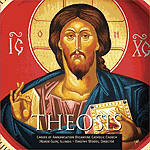
Theosis: Deification in Christ and the Jesus Prayer

Christianity Today in its October, 2008, issue has published James R. Payton's fine essay, "Keeping the End in View: How the Strange yet Familiar Doctrine of Theosis Can Invirgorate the Christian Life." Among the Orthodox theosis is a well-known Biblical way of envisioning what happens in the Christian life, and among Lutherans there is renewed interest in theosis inasmuch as Luther articulated its dynamics in his sermons and commentaries on Scripture. This morning I received the following quotation excerpted from William Ryan's Entering the Stream of Mercy in the Jesus Prayer (Avalon Counseling Contemplative Spiritual Resource), and made available by CENTER-L@heartoftexas-co.org. If you've not familiar with theosis and the Jesus Prayer, this quotation may give you much to meditate upon:

Living the Life of Christ in the Jesus Prayer

Jesus said "I came that they should have Life and have it fully. " (Matt.10:10). The goal of our life is to unite our human life, our human soulutterly with His Life, and to receive the gift of himself that he wants togive. This is a life-long process of opening and receiving and bringingf orth this union with Jesus, so that he can live fully in us. In the JesusPrayer we open and receive this union. When we are in a relationship of love or close friendship, there are times when we simply abide in the presence of our human beloved one. There are other times when we express ourl ove and givenness in words and rituals of love. My path is that of innercommunion with Christ, my Beloved, the emanation of the Godhead as Person. My practice is the disciplined daily self-offering in love that I make toand with Yeshua, giving of the gift of my person and receiving the gift of His Person. My day begins and ends with the invocation in vocalized chant,"Yeshua (Jesus), Yeshua (Jesus), You in me, I in you." Everything else is the actualization of that singular desire, that singular intention. This is Theosis, Christ living in us and we living in Him, the foundation of spirituality and transformation in Eastern Christianity. We are the beloved disciple; our calling is to "abide in his love." In this way over time we can begin to say as St. Paul does, "I live, no longer I, but Christ lives in me." (Gal. 2:20)

Image Credit: http://www.byzantinecatholic.com/images/THEOSIS.gif


Thursday, September 25, 2008

O, That Weather Forecasting Might Be Like This!

Some among us sing the Psalms appointed for Morning and Evening Prayer to various tones. Lutherans and Epicopalians, along with dear Presbyterian and Methodist friends, are especially prone to such psalmodizing. In the spirit of good-spirited communion, Fr. Tim Graham, rector of the Church of the Good Shepherd, Covington, Georgia, has sent this delightful uTube video for everyone's enjoyment:


Thanks, Fr. Tim!

Getting Ready for the Twentieth Sunday after Pentecost: June 15

Preparing for Sunday's worship? Spend some time with "Repentance: Cleaning Up the Messy House," Daniel B. Clendenin's essay on the lectionary readings. You may also wish to read his review of Martin Marty's The Christian World; A Global History by Martin Marty. And don't forget, on Monday, September 29, we celebrate St. Michael and All Angels.

Image credit: Ezekiel, 1308-11, Tempera on wood, 43,5 x 16 cm, National Gallery of Art, Washington.

Friday, September 19, 2008

Guardian Angels

I think it was last night that one of the evening news programs presented a short report on the high percentage of Americans who believe in angels. That prompts me to say a few words about Luther's Morning and Evening Prayers. In his Small Catechism (which I had to memorize at a young boy), Luther provides instructions on "How the head of the family should teach his household to pray morning and evening." Within those instructions, Luther urges that I ask the Heavenly Father to "let Thy holy angel be with me, that the wicked foe may have no power over me." In the Defense of the Augsburg Confession those who agreed with Luther said that they "grant that the angels pray for us," that is, because we need protection, the angels pray for our salvation.

One of my favorites hymns, "Ye Watcher and Ye Holy Ones," is a song addressed (the technical term for the rhetorical figure is apostrophe, a turning aside and speaking to someone or something not visibly present) to the seraphs, cherubim, among other heaveny dignitaries and saints. In the second stanza, we singers ask the Blessed Virgin Mary (she who is "higher than the cherubim, more glorious than the seraphim") to "lead their praises"; that is, we ask the Mother of God to be our lead voice as we sing praises to God with the angelic choirs.


In the Eucharistic Liturgy, as a preface to our singing the Sanctus--Holy! Holy! Holy!-- the pastor chants or says, "Therefore, with Angels and Archangels, and the whole Company of Heaven, we laud and magnify Your glorious name, singing . . . ." During the Liturgy we join our voices with the heavenly choir. We sing to God with angels.

In the prayerbook June and I use for Evening Prayer, after singing Psalm 141, there's a quiet call for meditative silence (allowing perhaps a review of the day), and then we say these words:
Let the incense of our repentant prayer ascend before you, O Lord, and let your loving kindness descend upon us, that with purified minds we may sing your praises with the Church on earth and the whole heavening host, and may glorify you forever and ever.
After that prayer, we sing several Psalms, aware that we are singing with "the whole heavenly host," that is, with all the saints and all the angels.

Sometimes when I'm with a small group of Christians gathered for worship and I find the sanctuary a bit empty of people, I like to remind myself that the place is crowded with the angelic hosts, who are always presenting themselves with us before God. There is no such thing as an "empty" church. The pews are filled with the choirs of angels.

I confess that generally speaking, I no longer use Luther's Morning and Evening Prayers (using instead the more traditional and historical daily offices). June and I do, however, pray before we travel from Kentucky to Georgia and back, asking God to send his accompanying angels with us as we speed down the highways at 70 mph. We need all the protection we can get.

All of which is to say that as I grow older, I'm also much more aware of who is with me. So I'm wondering: does the presence of angels and your awareness of their protection and assistance in worship find expression in your prayer life and adoration of God? Just curious.

Two New Sites for Pilgrimaging

Today I'm adding two websites to our list of Places to Visit.

The first is Monasterion; it announces itself as an "international (real and virtual) online monastery, fraternity open to anyone." Providing "information and answers (e.g., on vocations, contemplation, links, and so on), Monasterion emphasizes that it does not proselytize; it does, however "promises vast prayer-related resources (texts, exercises, links).

The second, for our readers interested in the Orthodox Tradition, is Silouan, the blog of an Assembly of God pastor who was received into the Orthodox Church. His posts are often excellent.

Thursday, September 18, 2008

The Family Monastery

This morning the mail brought me the September 2008 issue of the Forum Letter, a newlsetter published monthly by the American Lutheran Publicity Bureau. One wonderful essay caught my attention: "The family monastery" by Pastor Brad Everett. It first appeared in The Forum, a publication of the Evangelical Lutheran Church in Canada's Synod of Alberta and the Territories. Inasmuch as it's available on the Web, I'm trusting it's all right (editing it ever-so slightly) to post it here for your convenient reading. I hope you like it as much as I do.

The Family Monastery

When asked what was the difference between a monk and a married man, St. John Chrysostom replied, “The married man has a wife.” I don’t think any violence would be done to this sentiment if the terms “nun” and “married woman” were inserted instead.

Think about that for a minute. Not in terms of the obvious difference between the two states of life, but what it says about those things they have in common. The monastic life conjures up images of a life set apart for simplicity, prayer, work, service to others and above all service to Christ, which, if Chrysostom’s statement is correct, should be said about families as well. But truth be told, those likely aren’t the first things that come to mind when talking about families these days—even Christian families.

But why not? Why shouldn’t our families and homes be places of prayer and work, simplicity and service? Some might say that comparing monastic and family life I am comparing apples to oranges, and besides, Chrysostom was an unmarried bishop in the 4 C, so what does he know about Canadian famil life in 2008?

No one told us

A reading of his book On Marriage and Family Life (a collection of his sermons and letters on the topics) shows the good bishop did understand families and proves the truth of the saying “The more things change, the more they stay the same.” Of course, there are differences between then and now, monasteries and family homes, but the question remains—why shouldn’t our families and homes be places of prayer and work, simplicity and service?

Picking from the variety of answers to that question I’d choose this one. No one told us our families and homes could be like that, or that it was within our power, with the help of the Holy Spirit, to do it. Overwhelmed by stresses, strains and societal pressures, our judgment was sufficiently clouded to prevent us from seeing this very real possibility.

While certainly much in our lives is beyond our control, we lost sight of those things we do have within our grasp—for example, our schedules. Life in a monastery is built around prayer; that is, the times for prayer are established first and then the rest of the day’s activities are slotted in around those times. Many of us unintentionally or otherwise, do the exact opposite. Appointments and activities get first priority in the schedule and prayer is slotted in afterwards (or not at all).

Yet there is nothing stopping us from reversing this process—from sitting down with a day-timer or calendar and establishing times and opportunities for family prayer, and letting the rest of life fit in around them.

Fair warning—this is hard and for the most part thankless work. We live in a world where one’s value is measured by what and how much we “do.” Prayer and devotions are not understood to be “doing” much of anything and so are not valued. But we need to remind ourselves that the world around us is not the final arbiter of what is important and necessary for our lives. Our time as individuals and families in this life is finite. We need to prayerfully set our own priorities for how to spend it, rather than allowing someone or something else to do it. We find time for those things most important to us. So before claiming a shortage of time, we might want to see if our practice reflects our priorities.

Removing the obstacles

Having set aside time for prayer the next question is often “What do we do?” In monasteries this is an easy one since services of prayer have developed over the centuries and are simply followed as a matter of course. But things like praying all 150 Psalms each week isn’t a realistic option for most individuals, let alone households with pre-schoolers. Unfortunately this is where many homes get hung up—obstacles block their view of the options.

So instead of being intimidated by what you can’t do, look at what you can. As a first step, take a look at your home, the personalities, gifts, inclinations and of course ages of the people that make it up. Looking for resources, the Lutheran Book of Worship has orders for the daily prayer offices, with notes on how to modify them for family use. This might not be for everyone, but don’t dismiss it out of hand as, at the very least, it’s a place to begin. It gives a framework
families can adapt to their situations and for those starting out, it will be trial and error, but that’s half the fun, because you are doing it as a family.

One family's way

Further, the times of prayer and practices of devotion a family develops are not necessarily all formal. By way of example (and not the best example by any stretch) here are some things our family has done. At every meal we hold hands and pray grace in unison. Doesn’t matter who is here or how old they are, the practice is the same. Before bed-time we gather at the kitchen table, light the candle in our Camp Kuriakos lantern and read a story from a children’s Bible. Now that the older two kids are reading we share this duty. We then sing a song of their choosing, usually “God Our Protector” or during Advent/Christmas “Angels We Have Heard on High.”

Prayer follows, sometimes everyone takes a turn, or requests are shared and I’ll pray. The time ends with the blowing out of the candle (or candles if it is Advent) and heading off to bed where we pray before tucking children in. Sometimes we sing the Nunc dimittis from the service of Compline (“Guide us waking O Lord, and guard us sleeping, that awake we may watch with Christ and asleep we may rest in peace. Lord now you let your servant go in peace…”). Yes, our children can sing Compline, much like they can sing most of the Sunday liturgy—kids pick up things much quicker than adults, it’s just a matter of them hearing it regularly.

At the bedside we pray the same prayer every night. “Dear Jesus, thank-you for today and for all the fun that Christopher, Maren, Bennett and Abbey had. Give them good night sleeps and happy dreams. Help them be all warm and snuggy and sleep all the night through. Help them to know how much you love them and how much mommy and daddy love them. In Jesus name, Amen.”

Oodles of blessings

We conclude with kisses and making the sign of the cross on their foreheads. We have blessed our children in this manner from the time each was born. As each child grows older, they do the same for their mom and me. And such blessings aren’t restricted to bedtime. Blessings are exchanged when one is going on a trip or staying overnight somewhere else. When guests leave our home, or we leave a home where we have been guests, our kids will regularly give blessings, something they started doing of their own accord.

These are some of our family’s practices. Some were intentional and others not, but the goal behind it all was to make the home a place of prayer. Or at the very least a place where prayer could happen, trusting that the other points of work, simplicity and service would grow out of the practice of prayer. We are not where we want to be in our family prayer life, because there is always room for growth. But we know there is the possibility and promise.

Pr. Brad Everett, lives in Standard, AB, with his wife Manny and children: Christopher (9), Maren (7), Bennett (4) and Abbey (11 months) and a large orange cat named Jens. He has served Nazareth Lutheran for over 7 years.

Tuesday, September 16, 2008

Pray for and help our Haitian neighbors

As you know, Hurricanes Gustav and Ike ravished the little country of Haiti. Many died, many are suffering, many are hungry. Our Haitian brothers and sisters need our prayers and help. Visit my September 16 posting at Peaceful Christians for information.

September 17: Hildegard of Bingen, Visionary

On September 17 we remember, celebrate, and thank God for Hildegard of Bingen, Visionary and Abbess, d. 1179.

Hildegard of Bingen, also known as Blessed Hildegard and Saint Hildegard, was a German abbess, artist, author, counselor, linguist, naturalist, scientist, philosopher, physician, herbalist, poet, visionary, and composer. Elected a magistra in 1136, she founded the monasteries of Rupertsberg in 1150 and Eibingen in 1165.

She is the first composer in the Western world with an extant biography. One of her works, the Ordo Virtutum, has been called the first form, and possibly the origin, of opera. She wrote theological, botanical, and medicinal texts, as well as letters, liturgical songs, poems, and the first surviving morality play, while supervising brilliant miniature illuminations. Listen to her O aeterne Deus, 1. Antiphon with Ps 109/110 from Vespers by von Hildegard von Bingen.


Source: prosepp's Channel on uTube

O God, by whose grace your servant Hildegard, kindled with the fire of your love, became a burning and shining light in your Church: Grant that we also may be aflame with the spirit of love and discipline, and walk before you as children of light; through Jesus Christ our Lord, who lives and reigns with you, in the unity of the Holy Spirit, one God, now and for ever.

Preparing for Next Sunday: September 21

To prepare you for attentive listening to this coming Sunday's lectionary readings, Daniel B. Clendenin offers this essay: "Are You Envious Because I am Generous?" The Economy and Geography of God's Grace.

Clendenin also reviews The Diving Bell and the Butterfly, a movie June and I watched about two weeks ago. Well worth the watching!
As some readers of this blog are likely aware, Thomas Keating founded the spiritual community of Contemplative Outreach and has been the central figure in guiding it.

Each year the community convenes a conference. This year it is scheduled for 24-28 September 2008, in Pittsburgh and the theme is "Unity: Oneness in Contemplation." Fr. Thomas and Fr. Laurence Freeman of The World Community of Christian Meditation are featured presenters. Their presentations will include dialog on how Centering Prayer and Christian Meditation (involving the use of a Christian mantra) each have distinctive features as methods yet serve a common purpose.

There will be a conference blog this year. Here is part of its Welcome message:

Guest bloggers at the conference will share session updates, perspectives and reflections to provide you with a window on the proceedings and a form of participation" even if you are not present. It is hoped this outward extension serves to share community.Words, still and moving images and sounds will be
posted daily.

The communities of Contemplative Outreach and WCCM are invited to visit here throughout the five days of the conference, read the latest posts and share comments, conversation and community." You are invited to visit the conference blog at http://contemplativeoutreach2008.blogspot.com/

Ron Barnett (Blog Host)

"What it is can't be said, but you have to say something." Thomas Keating

Monday, September 01, 2008

September 1-13: A Quiet Few Weeks

Looking at my calendar, I see that the days ahead are relatively quiet ones. Lutherans will be remembering several of our fathers in the faith: September 2, Bishop Gruntvig, Renewer of the Church, d. 1872; September 4, Albert Schwitzer, Missionary, d. 1965. Among those of other traditions in our calendar over the next two weeks: on the 9th, Anglican Peter Claver, Priest, d. 1653; on the 13th, Bishop John Chrysotom, d. 407. On September 8th, we remember the Nativity of the Blessed Virgin Mary, and on September 14, we celebrate Holy Cross Day. At Faith Lutheran Church in Lexington, we have a good tradition for Holy Cross Day; weeks in advance, parishioners bring any old, extra, unused crosses to church, and then on Holy Cross Day, we take them out and around the city, to be given to those in need, the poor, the house-bound--anyone who wants a cross to remind them of God's love. As I have time and opportunity, I'll post a few remarks about each person and/or day.

In the meantime, I'll be posting some reflection on The Attentive Life that you might like to read. The book, by Leighton Ford, is a joy to read.

In the middle of this week June and I are driving down to Georgia by way of Nashville (to visit my son, Kirk), and on Sunday morning next, we board a bus for a tour up the coast to New York City. Sponsored by the Senior Center in Barnesville, Georgia, the whole thing is a ride with some of June's girl friends. "O frabjous day! Callooh! Callay!'

On the way I'll be working on a few more lessons in my study of The Benedictine Rule and reading a few books to while away the time. When we unload along the way, I'll try to get online with my laptop and share a few thoughts. In case you're interested, in addition to Benedict and Ford, here's what I'm taking along to read: John Chryssavgis, In the Heart of the Desert: The Spirituality ofo the Desert Fathers and Mothers, Brian McLaren, Finding Our Way Again: The Return of the Ancient Practices, Graham Greene, The Comedians, Mark Galli, Beyond Smells and Bells: The Wonder and Power of Christian Liturgy, and Matthew Levering, Ezra & Nehemiah (newly published from the Brazos Theological Commentary on the Bible).

We'll be staying three nights at some casino in Atlantic City. Can you imagine? I find no joy in gambling (nary a dime in a slot), so I suppose I'll watch in amazement. Or be up in the room, reading. Thank God for the psalms.

Thursday, August 28, 2008

August 29: The Beheading of St. John the Baptist

And when Jesus received [the news that John has been beheaded], he withdrew by boat to a lonely place where he and his disciples could be by themselves" (Matthew 14.13).

Matthew in Chapter 14 tells the story of the beheading of John the Baptist; it's a grisly tale that takes place during a birthday party--Herod's. Not unsurprisingly (if I have the details right), this is the Herod who is the son of the man who butchered the babies when Jesus was a toddler. Things do run in families. It must have been quite a good party: lots of booze, pole-dancing girls, loads of bawdy talk, a few salacious eye-winks, a table full of gifts, great food: in short, a blast of conspicuous consumption. And eventually John's head brought in with a lots of "O, look! Salome has got her wish!" Herod's wife smiled. John, telling truth to the Powers, had really irritated her.

You can imagine how saddened and depressed Jesus must have been upon getting the news. After all, John and Jesus were not only cousins; John had been been a "pastor" to Jesus. They knew each other well, so well that when Jesus comes over the horizon at the river and asks to be baptized, John, knowing Jesus from childhood on up, first wants nothing to do with such an apparently inappropriate baptism. Jesus insists, goes down into the soaking water, and comes up with the Father's blessing.

Now his pastor is dead: executed. Shocked, traumatized, in deep sadness, Our Lord wants to get away. Understandably. He heads by boat for the desert, the Silence of God. It doesn't work. Hoards of people are on his trail, eventually disrupting His solitude, forcing him to see them with pity, begging him to heal them. Whoever said grief was easy?

Then comes the great contrast: the other party, the party that begins with scraps of food and ends with baskets of leftovers. The contrast is startling: Herod at his night club, Jesus in the desert. A birthday party with John's unwrapped head as grisly gift. A picnic with thousands who receive bread and the Bread of Life.

I imagine that while Jesus was feeding those people, going around shaking hands, making sure that everyone got blessed and fed, that He did all of that in spite of the sadness in His heart. Jesus pressed on to bless in spite of knowing what happened to His pastor. Jesus fed everyone while the memory of His mentor's death went unabated.

Jesus still presses on today while knowingly bearing the suffering all martyrs. And when we made and make him a martyr, he surely loved, loves, and blesses us. As I wonder about all of this, I also ask myself, "Did the Man who asks us to love our enemies also love Herod and his family?" Did He pity and have compassion on those who killed His pastor?" Did he want to be alone to find out? Did the compassion and forgiveness He came to know for Herod's family find expression within his feeding of the thousands? Were the two compassions connected? I think so. When we love our enemies, it becomes inevitable that we love our neighbors, the thousands near to us.

Image: Carravagio, The Beheading of St. John the Baptist

Wednesday, August 27, 2008

August 28: St. Augustine, Bishop of Hippo, d. 430

On Thursday we give thanks to God for Augustine, the great late fourth-century theologian, whose writings have influenced the western Church perhaps more than any other Christian. In my collection of books is one I especially treasure: Augustine through the Ages: An Encyclopedia, ed. Allan D. Fitzherald, O.S.A, with a forward by Jaroslav Pelikan, who says:

[Augustine] is . . . "the only church father who even today remains an intellectual power." The reason for this unique position is that "irrespective of school and denomination [Augustine] attracts pagans and Christians, philosophers and theologians alike by his writings and makes them come to terms with his intentions and his person" (xiii). That being said by this century's most famous Church historian, I too like Augustine, not so much because he's brilliant (he is!), but because he's also so deeply human as a Christian. On his memorial day, I always read Chapter 9 of his Confessions and began doing so early this morning. In Chapter 9 Augustine tells the story of his turning to God, his baptism, and development of his new life in Christ. I hope a sentence or two will give you a sense of his new-found joy as he prays his autobiography to God:

During the days that followed [my baptism], I could not get enough of the wonderful sweetness that filled me as I meditated upon Your deep ddesign for the salvation of the human race. How copiously I wept at your hymns and canticles, how intensely was I moved by the lovely harmonies ofyour singing Church! Those voices flooded my ears, and the truth was distilled into my hdeart until it overflowed in loving devotion; my tears ran down, and I was the better for them.
Today lots of voices are thanking God for Augustine, and one of the best is that of Padre Mickey, a Panamanian missionary/priest who a year ago on his blog, Dance Party, nicely introduces us to the best of Augustine. Admiting that at first he didn't warm up to Augustine, his posting for the feast day will help you appreciate Augustine as much as Padre Mickey does now. Once there, you find that the collect of the day is at the top of Padre's posting:
Lord God, the light of the minds that know you, the life of the souls that love you, and the strength of the hearts that serve you: Help us, following the example of your servant Augustine of Hippo, so to know you that we may truly love you, and so to love you that we may fully serve you, whom to serve is perfect freedom; through Jesus Christ our Lord, who lives and reigns with you and the Holy Spirit, one God, now and for ever. Amen.

Tuesday, August 26, 2008

August 27: St. Monica

On August 27 we remember St. Augustine’s mother, Monica. She was born at Thagaste in Africa of a Christian family. She was married young, to Patricius, and among her children was Augustine. He had a brilliant intellect and uncertain morals and his wayward spiritual career saw him at one time a Manichee and then a Neoplatonist. With many tears she prayed unceasingly to God for his conversion and her prayers were answered shortly before she died. She had a deep faith and outstanding virtue and is a wonderful example of a Christian mother.

I first met St. Monica fifty years ago and later renewed by acquaintance of her when I began teaching The Confessions of St. Augustine thirty years ago. The course was World Literature I, and our text had substantial excerpts from The Confessions, one of which was most of Book IX containing Monica’s story, their days at Ostia, her death, Augustine’s grief and his eventual coming to peace. The story is a good one, and I’ve often taken comfort in knowing that God hears my prayers for my children, like Monica’s for her son Auggie; though things often seem uncertain with the kids, I can be certain that God will bless my family. If you haven’t read The Confessions, you might well give it a try.

Here’s a prayer by which the Church gives thanks to God for the life of Monica:


God of mercy, comfort those in sorrow, the tears of Saint Monica moved you to convert her son Saint Augustine to the faith of Christ. By their example, help us to turn from our sins and to find your loving forgiveness. Grant this through our Lord Jesus Christ, your Son, who lives and reigns with you and the Holy Spirit, one God, for ever and ever. Amen.

Monday, August 25, 2008

Looking Ahead: Monica, Augustine, and the Beheading of St. John the Baptist

Most liturgical/church calendars this week urge us to remember the lives (and one death) of three witnesses to the Faith: On Wednesday, the 27th: Monica, the mother of Augustine, d. 387; on Thursday, the 28th, her son, Augustine, Bishop of Hippo, d. 430; and on Friday, the 29th, the Beheading of St. John the Baptist. If your prayerbooks take note of these days, you may wish now to anticipate the readings and prayers. On the night before each day, I'll post reminders and additional helpful information about each of these Christians.

The Attentive Life: Discerning God's Presence in All Things

A quick reminder: at The Attentive Life we've set up a new blog for those who are interested in discussing Leighton Ford's new book. The new link on the right will take you there.

Pericopal Politics

Here's something interesting that came in from getreligion@getreligion.org this morning; I think you might enjoy it!

Pericopal politics

By: Mollie

liturgical calendarConsidering how many Christians follow the liturgical calendar, the media seem not to get it. In a news environment that seeks change and conflict, the liturgical calendar is a constant.

Each year, liturgical congregations — which include, Roman Catholic, Episcopal and Lutheran churches, work through every major part of the Holy Bible and the story of salvation accomplished through Jesus Christ’s life, death and resurrection. The church has, through tradition, assigned Old Testament, New Testament and Gospel readings that are to be read to the congregation. Each week also has its own Psalm and other liturgical elements unique to the day. The sermon is built around these readings.

Keep that in mind as you read this Los Angeles Times report of Barack Obama’s visit to a church yesterday:

Barack Obama began his campaign day in Eau Claire, Wis., surprising most of the congregation at the town’s First Lutheran Church by attending service there. But Pastor John Kerr had been tipped that his listeners might include the almost-official Democratic presidential nominee, and he was ready with an on-point message.

Obama brought his own Bible and settled into an aisle seat in the fourth row. Kerr’s then offered as his first reading Romans 12:1-8 — which preaches humility.

Indeed, according to pool reporter John Broder of the New York Times, Kerr summarized its thrust as counseling against cockiness because one is a good singer or public speaker. And the passage urges one “not to think of yourself more highly than you ought to think but to think with sober judgment, each according to the measure of faith that God has assigned.â€?

In his 13-minute sermon, Kerr refrained from any mention of Obama or politics.

Um, no, the pastor didn’t include Romans 12: 1-8 as his “first” (first?) reading because he’d been tipped off that Obama might attend. I’d be willing to wager that the pastor follows a three-year lectionary. Some congregations, like mine, follow a one-year calendar. Others use a three-year cycle so that you repeat the readings every three years. Anyway, it just so happens that the first year of the three-year lectionary lists the following readings for August 24, the fifteenth Sunday after Pentecost:

Is. 51:1-6
Psalm 138
Rom. 11:33-12:8
Matt. 16:13-20

Liturgical calendars are created precisely to help pastors avoid preaching on whims or fancies that may detract from the overall message of Christ and his crucifixion. And while I’m sure any pastor and congregation would be excited to have Barack Obama or any other major political figure in their midst, sermons aren’t supposed to be composed for one individual. Lutherans believe that the Romans passage applies to everyone, not just high-profile members of the day’s congregation.

I know that reporters like to think that everything is about politics. But some things are more important than politics.

Sunday, August 24, 2008

August 24: St. Bartholomew, Apostle

Today is one of those Sundays which can go in two directions. As the Fifteenth Sunday after Pentecost, some parishes will keep time holy as does Daniel B. Clendenin at Journey with Jesus with his commentary on the appointed readings: Isaiah 51:1–6, Psalm 124 or Psalm 138, Romans 12:1–8, and Matthew 16:13–20. Many pastors will be preaching on the Gospel narrating Peter's confession that Jesus is "The Christ, the Son of the living God." Other pastors, however, may ask us to observe that today is also a time to remember St. Bartholomew, one of the twelve Apostles known to us only by his being listed among them in the Gospels according to Matthew, Mark, and Luke. What we know about Bartholomew, as the Lesser Feasts and Fasts tells us, is very little:

His name means "Son of Tolmai," and he is sometimes identified with Nathaniel, the friend of Philip, the "Israelite without guile" in John's Gospel, to whom Jesus promised the vision of angels ascending the descending on the Son of Man. Nothing more is heard of him in the four Gospels.

There are, not unsurprisingly, a good many legends about Bartholomew, one being that he was flayed alive at Albanopolis in Armenia. On the whole, however, there's really not much to say about him.

It seems to me, however, that "not much" says a lot, both about Bartholomew and about us. Not much will be said about most of us. We may get an inch or two in the local obituary listings after our deaths, but after a decade or two, "not much" will be about all that can or will be said of us. Who were you, Andy? Not much. Who were you, Bill, Mary, and Sam? Not much. Except, of course, in God's remembering and mercy. God will always remember us in Christ, and that is the great comfort of this Sunday for those who remember "not much" Old Bart, as a friend of mine once named him.

After all, it is always God who does the Great Remembering. He "re-members" us; that is, moment by moment He puts our "members" (the parts of us: body-parts, spirit-parts, soul-parts, mind-parts, heart-parts) together, especially by placing us in the Resurrection of our Lord Jesus. As the people of God gather for worship and Holy Communion this morning, God will again "re-member" us, turning Bartholomew's and our "not much" into the Body of Christ, partakers of His divine nature, the "muchness of Christ."

No wonder we want to pray one of this day's collects:

Almighty and everlasting God, who gave to your apostle Bartholomew grace truly to believe and to prach your Word: Grant that your Church may love what he believed and preach what he taught; through Jesus Christ our Lord, who lives and reigns with you and the Holy Spirit, one God, for ever and ever. Amen.

Tuesday, August 19, 2008

August 20: Remembering Bernard of Clairvaux

Tomorrow is one of my favorite days for remembering great Christians. Although I’ve only read one of his books (his commentary on the Song of Songs I, a collection of sermons), I fell in love with St. Bernard's wisdom and insights. Take this, for example, from Sermon 12, “The Grace of Loving Kindness”:

And you too, if you will permit us your companions to share in the gift you have received from above, if you are at all times courteous, friendly, gentle and humble, you will find men everywhere bearing witness to the perfumed influence you radiate. Everyone among you who not only patiently endures the bodily and mental weaknesses of his neighbors, but, if permissible and possible, even plies them with attention, inspires them with encouragement, helps them with advice, or, where the rule do not so permit, at least does not cease to assist them by fervent prayers—everyone, I repeat, who performs such deeds among you, gives foreth a good odor among the brethren like a rare and delicate perfume. (81)
An abbot in the Cistercian order, St. Bernard's puritan-esque biblical reliance and work ethic make plain the reasons why Calvin and Luther held him in high esteem. As a monastic forerunner of the Reformation, St. Bernard of Clairvaux stressed the love of God as central to any theological undertaking or Christian living. Theo M. M. A. C. Bell nicely summarizes Luther's relationship to Bernard:

On his road to the reformation Bernard was a true companion to Luther; but also in his later years Luther remembered Bernard as the greatest of all the fathers of the church after Augstine.Certainly Luther must have been aware also of several differences between himself and Bernard, but to Luther these were matters of minor importance. Their theologies circled around the same focal point of personal experience of the Holy Writ. William of St. Thieny states in his hagiography that Bernard often used to say, "It is better to drink from the source itself than from the many streams." Almost four hundred years later a doctor of Scripture at the University of Wittenberg would make this saying very much his own. ("Luther's Reception of Bernard of Clairvaux," CTQ, 59:4: 267)

St. Bernard's writing and numerous other contributions to the Church are chronicled in this info-saturated issue of Christian History & Biography.

If you like that sermonic excerpt and want to know more about St. Bernard, you can find out more about him here and then perhaps offer this prayer in thanksgiving to God for giving us such a Christian father in Christ:

O God, by whose grace your servant Bernard of Clairvaux, kindled with the flame of your love, became a burning and a shining light in your Church: Grant that we also may be aflame with the spirit of love and discipline, and walk before you as children of light; through Jesus Christ our Lord, who lives and reigns with you, in the unity of the Holy Spirit, one God, now and for ever.

Monday, August 11, 2008

Leighton Ford, The Attentive Life

Today I received my copy of Leighton Ford's The Attentive Life: Discerning God's Presence in All Things (Downers Grove, IL: IVP Books, 2008). This is the book Mason Smith has recommended for those of us in a small Sunday School class that meets in the undercroft of First United Methodist Church, Richmond, Kentucky.

Inasmuch as I'm not a typical evangelical (for me, the word evangelical is always hyphenated with the word catholic so as to describe one who is evangelical-catholic), I must confess that although I faintly knew that Leighton Ford is an evangelist, long associated with the Billy Graham Evangelistic Association, it came as something of a surprise (oh, heck, say "big surprise"!) to find out that Ford's Attentive Life is a wonderfully compelling invitation to a life of prayer he discovered at Mepkin Abbey by the Cooper River in South Carolina. With chapter subtitles like "ONE WHO PAID ATTENTION: Simone Weil on a Postage Stamp," one quickly intuites that Ford knows how to share the "hours" with witful intelligence, charm, and winsome conviction.

While I've only begun to dip into this delightfully well-written book (and will certainly plunge into it more fully tonight), I must tell you that I think nearly everyone will enjoy it, find it exceptionally helpful in encouraging an attentive prayer life, and provide any group with a host of insights, provocations, and layered viewpoints for discussion. I'm delighted that we're about to discuss the book at some length. Thanks, Mason, for suggesting that we read it.

August 11: Clare, Abbess at Assisi, 1253

In many church calendars today we are asked to remember and thank God for Clare of Assisi. In honor of her feast day, Paraclete Press provides us with these words from St. Clare:

Keep Doing What You Are Doing

What you are doing, may you keep on doing and do not stop. But with swiftness, agility, and unswerving feet, may you go forward with joy and security knowing that you are on the path of wisdom and happiness. Believe nothing, and agree with nothing that will turn you away from this commitment. Nothing should be allowed to prevent you from offering yourself to the Most High in the perfection to which the Spirit of God has called you. Amen.


The Collect
O God, whose blessed Son became poor that we through his poverty might be rich: Deliver us from an inordinate love of this world, that we, inspired by the devotion of your servant Clare, may serve you with singleness of heart, and attain to the riches of the age to come; through Jesus Christ our Lord, who lives and reigns with you and the Holy Spirit, one God, for ever and ever. Amen.

Looking forward to next Sunday, the Fourteenth after Pentecost

It's always good to wake up to Dan's Monday a.m. posting; here it is:

JwJ Readers,

Click here for our home page: http://www.journeywithjesus.net/.

"All the Ends of the Earth" is the title of this week's essay. What are the practical implications of the global nature of God's kingdom?

I review a book on Eastern Orthodoxy called Encountering the Mystery (2008) by Patriarch Bartholomew, and a crazy film that's well worth watching called What Would Jesus Buy? For poetry we've posted "A Nation" by the Nobel laureate Czeslaw Milosz (1911–2004).

Don't miss Dave Werther's new music review of the indie folk-rock group Southeast Engine and their CD "A Wheel within a Wheel."

For August 24: "Positively Maladjusted" (Romans 12:1-2)

Don't forget our comprehensive archives of more than 1,100 essays, reviews, and poems---all free, all the time. You can "Search our Site" by entering any key word, name, passage, etc.
--Dan

Daniel B. Clendenin, PhD
265 Cambridge Avenue, PO Box 60781
Palo Alto, California
https://www.journeywithjesus.net (a weekly webzine for the global church; 220 countries served)

Saturday, August 09, 2008

More Words and Pictures from Haiti

On July 28, after visiting with Fr. Andre Augustine at St. Francis of Assisi parish, George Derval, the mayor of Ranquitte, asked us to drive out with him in his pickup to meet Harry Chel-Hilaire (known as "Capo") and his four-year-old son, Capito. Capo has been severely lame since birth. Capito's mother died several years ago. The two of them live in a small hut, about the size of a large dog-house; it's roof consists of large palm leaves. When it rains, as it had with torrential downpours during the week, Capo and Capito are resigned to living and sleeping on a mud floor.

"Surely this is intolerable," George quietly told us. "We must do something right away--perhaps now--to help Capo and Capito." Within a few minutes it was agreed that Capo and his son needed immediate temporary quarters, and arrangements were made for a temporary home of posts, tin roof, and wood siding be built within the week. Something much better, although admittedly temporary, could be built for 380 U.S. dollars. George promised to make sure that within a day or so, Capo and his son will sleep on a dry dirt floor.

And inasmuch as Capo was literally "squatting" on someone's else property, it was also decided that he should be provided with some property, the cost of which would be about 250 U.S. dollars. And in addition, because Capo and Capitoare depend entirely for food on the help of their neighbors, provisions for a month's store of rice and beans was made.

Capo makes his way around by sitting on a large palm branch, and by using two short poles, he is able to push himself along the ground (provided, of course, that it is not to rocky or rough). He scoots around rather quickly in his small dirt yard. And Capito follows along, his hand on the head of his father. The love between this father and son is wonderful to behold.

When our team goes back to Haiti in mid-January, we will build a more permanent home for Capo and Capito, a home with a concrete floor, concrete blocks (made on site), a tin roof, small rooms for cooking, sleeping, and storage--and a real door. All on a bit of land Capo may call his own.

Capo makes his meager living by weaving rope, and it is hoped that my moving him and his son closer to the village of Ranquitte that perhaps a way will be found to Capito to go to school in a year or so.

We are grateful to George Derval for introducing us to Capo and Capito, two of God's beloved poor. As we remember this father and son in our prayers, we ask you to join us in remembrance of their needs.