Monday, December 29, 2008

Thomas Merton on Contemplation: Two Observations

Each week The Merton Institute sends out one or more reflections taken from Thomas Merton's writings. Here is the week's reflection:

True contemplation is the work of a love that transcends all satisfaction and all experience to rest in the night of pure and naked faith. This faith brings us so close to God that it may be said to touch and grasp Him as He is, though in darkness. And the effect of such a contact is often a deep peace that overflows into the lower faculties of the soul and thus constitutes an "experience." Yet that experience or feeling of peace always remains an accident of contemplation, so that the absence of this "sense" does not mean that our contact with God has ceased. Thomas Merton. (New Seeds of Contemplation. New York: New Directions Press, 1961, 211)

You will never be able to have perfect interior peace and recollection unless you are detached from even the desire of peace and recollection. You will never be able to pray perfectly until you are detached from the pleasures of prayer. (New Seeds of Contemplation, 208)

From my chapbook of thoughtful sayings

Benedict Groeschel says, "A saint is just a sinner who is more repentant than most of us."

Getting ready for next Sunday, January 4, 2009

Each Monday morning I receive a weekly essay on the Biblical lectionary by Daniel B. Clendenin. Here's the beginning of this week's essay:

Last month I called Palo Alto's Friends of the Library to help me purge my bookshelves. They hauled away thirty-two cartons — 1,002 books, if I counted correctly. What was interesting was not the books that I gave away, but the ones I kept. When I looked at the few books that I kept, I noticed that a large percentage of them came from the desert monastics of the fourth century. Read more . . . .

Saturday, December 27, 2008

Learning to face Facebook

For the past half-year people have been inviting me to Facebook, and in the past few days I've been exploring the phenomenon. For what it's worth, I'm there now, staring at I-don't-know-what and gazing fixedly at the "wall." It's an interesting village! I've found a namber of groups focused variously on Centering Prayer, the Divine Office, The Cloud of Unknowing, and the witness of Tom Merton, among other interesting areas of interest. If you are ever somewhere in the area, whistle "hello!" and show me the way around!
Andrew Harnack's Facebook profile!

Prayer Shawls and Tallits

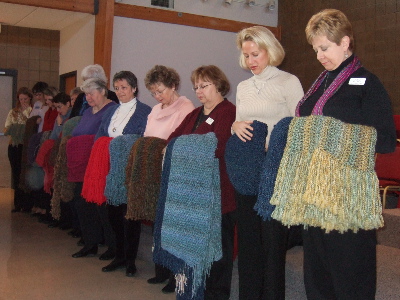
Danielle is knitting a prayer shawl for a friend who has been diagnosed with a recurrence of breast cancer. As Danielle knits, she is both praying over the shawl for her friend’s restoration to health and asking others to join her so that eventually the shawl is saturated with prayers. When Danielle finishes her knitting, she will give the prayer-soaked shawl to her friend as a gift heavy with hopes and intercessions for healing.

When Danielle asked if I’d like to participate in the praying and preparation of the shawl, my musings about prayer shawls led me to remember that Jesus might well have used and recommended prayer shawls as an aid to “secret prayer” in Matthew 6.6:


But when you pray, go to your private room and, when you have shut your door, pray to you Father who is in that secret place, and your Father who sees all that is done in secret will reward you.
Here Jesus urges that we enter a private room (other translations call it a “closet,” “a quiet, secluded place,” “chamber,”) to circumvent any ego-driven tendency to ostentatious praying. Some commentaries suggest that Jesus’ word for closet--in the Greek New Testament (τὸ ταμεῖόν, to tameion) is best understood as a reference to the Jewish prayer-shawl, the tallit, traditionally used by observant Jews during prayer. The wearing of the "tallit" (Hebrew: טַלִּית‎, pronounced tal-eet), also called the "tallis" or "prayer shawl," was commanded by God in Num.15:37-40:


God spoke to Moses: "Speak to the People of Israel. Tell them that from now on they are to make tassels on the corners of their garments and to mark each corner tassel with a blue thread. When you look at these tassels you'll remember and keep all the commandments of God, and not get distracted by everything you feel or see that seduces you into infidelities. The tassels will signal remembrance and observance of all my commandments, to live a holy life to God. I am your God who rescued you from the land of Egypt to be your personal God. Yes, I am God, your God."
Lest we forget that Jesus was thoroughly Jewish and that he observed that commandment, it may be helpful to picture Jesus as always wearing his tallit or prayer shawl. Indeed, Jim Gerrish is quite right to remind us that we can be assured that he wore one. Marc Chagall's "The Praying Jew" might well give you the image of Jesus that fits what we know about the way Jesus looked when wearing his prayer shawl.

Had he not done so, he would have broken the very law that he came to uphold. The law concerning the wearing of such garments is found in Numbers 15:37-49. These garments were certainly still worn in Jesus time, because along with the discovery of the Dead Sea Scrolls, a tallit was found almost intact. It can be seen on display today at the Shrine of the Book in Jerusalem.

On one occasion a sick woman came and touched what must have been the fringes (tzitzit) of this garment, and in so doing, she was healed (Mk. 6:53-56). Traditionally the four corners of the tallit are called "the four wings." Perhaps she had in mind that phrase in Malachi 4:2, which speaks of the Messiah as one with "healing in its wings."

The clear implication is that at Matthew 6.6. Jesus is recommending the use of one’s tallit as a closet, inner room, or secret place.

This interpretation is born out when we remember that TALITH contains two Hebrew words; TAL meaning tent and ITH meaning little. Thus, you have LITTLE TENT. Each man had his own little tent. Six million Jews could not fit into the tent of meeting that was set up in the Old Testament. Therefore, what was given to them was their own private sanctuary where they could meet with God. Each man had one! His Prayer Shawl or Talith. They would pull it up over their head, forming a tent, where they would begin to chant and sing their Hebrew songs, and call upon God. It was intimate, private, and set apart from anyone else -- enabling them to totally focus upon God. This was their prayer closet! (The Hope of Israel)
As Danielle knits her prayer shawl for her friend, she is encouraging the revival of an ancient prayer tradition—the use of a tallit; and moreover, remembering Jesus’ encouragement of its use for “secret prayer,” Danielle might also be suggesting a prayer shawl is perhaps an apt aid to Centering Prayer, prayer spoken only to God in secret, deeply interior prayer, prayer that forsakes not only public ostentation but also minimizes as much as possible the interruption of private thoughts, images, imaginative speculations, interior story-telling, and pious perceptions, no matter how "holy" they may be.

Surely we enter our closets by simply closing our eyes. Many, however, also find it helpful to pray in a darkened room or at night. If those practices are helpful, surely the use of a prayer shawl might also be beneficial in that it may help us—as Jesus recommends—to physically close the door to distractions and nearby disturbances.

Personally I don’t own or use a prayer shawl, but in Centering Prayer I sometimes pull the hood of my so-called sweat-shirt up so as to bury my head inside something much like a tallit. Now, however, that Danielle has gotten me interested, I may start actually thinking about using one. Methodist women, like Danielle, seem to be leading the renewal of tallits as gifts, prayer closets, and aids to healing. If you’re interested, you might like to visit one or more of the following:

May God bless Danielle's knitting and prayers for her friend.

Images: Marc Chagall (Russian-born French painter, 1887-1985), "The Praying Jew" (1923, copy of 1914 work), oil on canvas, 116.8 x 89.4 cm, Art Institute of Chicago; The blessing of shawls made by Methodist women


Monastic Skete

Found a good blog this morning: Dan Phillip's Monastic Skete (a skete is a settlement of monks or ascetics). Dan is wise Baptist pastor who likes Tom Merton. You need to meet him, and so I'm adding Monastic Skete to our list of places to visit so you can tromp on over now and then when you come visiting here. To give you a preview as to what sorts of things Dan is up to, here's a poem that Dan wrote and posted on December 16:


FIRST CORINTHIANS 13 (paraphrased)

CHRISTMAS VERSION

If I decorate my house perfectly with plaid bows,
Strands of twinkling lights and shiny balls,
But do not show love to my family,
I'm just another decorator.
If I slave away in the kitchen, baking dozens of Christmas cookies,
Preparing gourmet meals and arranging a beautifully adorned table at
mealtime,
But do not show love to my family,
I'm just another cook.
If I work at the soup kitchen, carol in the nursing home
And give all that I have to charity,
But do not show love to my family,
It profits me nothing.
If I trim the spruce with shimmering angels and
crocheted snowflakes,
Attend a myriad of holiday parties and sing in the choir's cantata,
But do not focus on Christ,
I have missed the point.
Love stops the cooking to hug the child.
Love sets aside the decorating to kiss the husband.
Love is kind, though harried and tired.
Love doesn't envy another's home
that has coordinated Christmas china and table linens.
Love doesn't yell at the kids to get out of the way,
but is thankful they are there to be in the way.
Love doesn't give only to those who are able to give in return,
but rejoices in giving to those who can't.
Love bears all things, believes all things, hopes all things, endures
all things.
Love never fails.
Video games will break, pearl necklaces will be lost, golf clubs will
rust....
But giving the gift of love will endure.
You can give without loving, but you cannot love without giving.

BRO. DAN AND THANKS ROGER WILLIAMS

Friday, December 26, 2008

December 26-31: The Witness Days

On the six days between Christmas Day and its Octave on 1 January, we remember five persons who have in various ways, by martyrdom or otherwise, born witness to the truth of the Christian faith.(Note that the word martyros in pre-Christian Greek simply means "witness," and that it is not always clear whether early Christian uses of it (as in Revelation 2:13) ought to be translated broadly, as "witness", or in the narrow technical sense as "martyr", that is, someone who has explicitly chosen to die rather than to deny Christ as Lord.)

On December 26th, we remember St. Stephen, first member of the early Christian church to be put to death for his faith -- see Acts 6,7. He was "a martyr in will and deed."

On December 27th, we remember St. John the Evangelist, one of the Twelve Apostles. It is commonly believed that, although he was imprisoned and beaten for his adherence to Christ, he lived to old age and died a natural death. He was "a martyr in will but not in deed," meaning that he was willing to lay down his life for his Lord, but was not called on to do so -- See M 20:20-28 = P 10:35-45.

On December 28, we remember the Holy Innocents, the children of Bethlehem who were slaughtered by command of King Herod lest one of them prove a danger to his throne -- see M 2:16-18. They were "martyrs in deed, though not in will," and their deaths are a disquieting reminder that suffering on behalf of a good cause is not always restricted to those who have a choice in the matter.

The witnesses commemorated on these first three days are all from New Testament times. On the two days following, we commemorate witnesses from a later period in Christian history. Taking them in reverse order of days --

On December 31 we commemorate Sylvester, bishop of Rome from 313 to 335 -- that is, roughly from the Edict of Toleration issued by the Emperor Constantine to the death of the said Emperor, and thus the first bishop of Rome in the days after Christianity ceased to be an illegal and persecuted religion. With his term of office, we enter an era when to become a Christian is no longer to place oneself in automatic danger of being put to death by the government. However...

On December 29, we remember Thomas a Becket, Archbishop of Canterbury, slain in his own cathedral in 1170, for his defiance of King Henry II. The death of Thomas reminds us that a Christian, even when safe from pagans, can be in danger from his fellow-Christians.Two recent additions to the Calendar are John Wylcif (31 Dec), a pioneer of Bible translation; and Josephine Butler (30 Dec), who came to the assistance and defense of women whom society had, in effect, declared outside its protection. Neither was (in the technical sense) a martyr. Both are witnesses.

In recent years, it has become the practice of some groups of Christians to give the First Sunday after Christmas precedence over the observance of these days, and so to postpone by one day those commemorations falling on or after that Sunday.

Again, presumably to avoid commemorations close to Christmas (just as we avoid them within seven days of Easter Day), some Christian groups have adopted alternate dates for some of these celebrations.

Thomas the Apostle: 3 July
Stephen the First Martyr: 3 August
John the Evangelist: 6 May
The Holy Innocents: 11 January (after the Magi on 6 January)
Thomas a Becket: 7 July

On January 1st, we celebrate the Circumcision of Christ. Since we are more squeamish than our ancestors, modern calendars often list it as the feast of the Holy Name of Jesus, but the other emphasis is the older. Every Jewish boy was circumcised (and formally named) on the eighth day of his life, and so, one week after Christmas, we celebrate the occasion when Our Lord first shed His blood for us. It is a fit close for a week of martyrs, and reminds us that to suffer for Christ is to suffer with Him.

Text source: The Witness Days
Source of images: St. Tom's Players

Wednesday, December 24, 2008

Christmastide

As we all know, the Feast of Christmas is not simply a one-day affair; it's a nearly two-week, twelve-day celebration of the Incarnation. It's really a "tide," "tidings" of days; and so remembering that the "tidings" (perhaps from Old Norse tīdhendi, events as "news events") of Christmas cannot be told in a mere day, the Church has extended its celebration for a whole row or days, making sure that we have plenty of time to receive the Lord Jesus in many ways, throughout many days. That's why we call the coming days Christmastide.

That, of course, is not to diminish the importance of Christmas Day, the Feast of the Nativity. As Christians, we surround that day with lights and candle-burning, with carols and cantatas, with church drama and creches, with parishes providing special services, and with exceptionally beautiful provisions for Morning and Evening Prayer. Take, for example, our local Episcopal parish in Covington, Georgia. This morning there is Eucharist at 11:00; then later at 5:00 p.m. and at 10:00 p.m., two more Eucharists! The Church of the Good Shepherd wants to make sure--no matter the work schedule (whether it's baking home-made cookies, driving a tractor-trailer, preparing for family gatherings, or working as a server in a restaurant)--that everyone has an opportunity to kneel at the manger and receive the Lord Christ. And at Faith Lutheran Church in Lexington, KY, Andy's home parish, there will Christmas Even Eucharists at 4 and 11 p.m. (with music 20 minutes before the services begin). And on Christmas Day, another Eucharist at 10 a.m. Everywhere we Christians all over the world are praising God for the gift of Jesus Christ.

As we worship our way through Christmastide, I'll be sharing my thoughts with you. For now, however, if you're attending an especially beautiful celebration of the birth of Christ, leave us a comment and tell us what your parish did in response to the love of God in Mary's Son.


Wednesday, December 17, 2008

Some Photographs

Dr. Joe King, who is going to Haiti with a group of us in January, has introduced me to a place where I can share some of my photographs with you. If you'd like to see them, go to http://harnacka.zenfolio.com/. I'll put up a more-or-less permanent link to my photographic work on this and the other blogs I try to maintain.

Stethoscope

You might like to watch (and listen) to this one.

Some thoughts on the Gospel lesson for the Fourth Sunday in Advent

The appointed Gospel reading for the Fourth Sunday in Advent is Luke 1.47-55; in many churches during worship we'll listen as the pastor or lector reads the Song of Mary, what many know as The Magnificat--what many sing or say every afternoon and/or night during Evening Prayer. Although you may know it well, look at it again:

And Mary said,

My soul proclaims the greatness of the Lord;
my spirit rejoices in God my Savior,
for he has looked with favor on his lowly servant.
From this day all generations will call me blessed;
the Almighty has done great things for me,
and holy is his name.
He has mercy on those who fear him in every generation.
He has shown the strength with his arm;
he has scattered the proud in their conceit.
He has cast down the mighty from their thrones,
and has lifted up the lowly;
he has filled the hungry with good things,
and the rich he has sent away empty.
He has come to the help of his servant Israel,
for he has remembered his promise of mercy,
the promise he made to our father,
to Abraham and his children forever.

If, however, we read several verses before coming to the Song of Mary, we have this context for her Song :

In those days Mary set out and went with haste to a Judean town in the hill country, where she entered the house of Zechariah and greeted Elizabeth. When Elizabeth heard Mary’s greeting, the child leaped in her womb. And Elizabeth was filled with the Holy Spirit and exclaimed with a loud cry, “Blessed are you among women, and blessed is the fruit of your womb. And why has this happened to me, that the mother of my Lord comes to me? For as soon as I heard the sound of your greeting, the child in my womb leaped for joy. And blessed is she who believed that there would be a fulfillment of what was spoken to her by the Lord.”

[The Song comes here!]

And Mary remained with her about three months and then returned to her home.

Thomas Keating in The Mystery of Christ: The Liturgy as Spiritual Experience shares his understanding of these contextualizing verses this way:

What is Mary's first response to the gift of divine motherhood? She goes to see her cousin Elizabeth who happens to be having a baby and who needs help with whatever you do when you are getting ready for a baby: making diapers, preparing
the bassinet, knitting little socks and bonnets. That is what she figured God wanted her to do. It never occurred to her to tell anyone about her incredible privilege. She simply did what she ordinarily did: she went to serve somebody in need. That is what the divine action is always suggesting: help someone at hand in some small but practical way. As you learn to love more, you can help more.

Mary did not go to counsel Elizabeth; she did not go to evangelize Elizabeth; she went to prepare the diapers. That is true religion: to manifest God in an appropriate way in the present moment. The angel had said that Elizabeth was soon to have a baby. Mary said, "Is that so? She must need help; I'll go at once." She went "in haste," manifesting her eagerness to be of service without any thought about her own condition, including, I presume, what Joseph or her mother were thinking about her unexpected pregnancy.

As the title of his book suggests, Keating is responding to what he hears during Advent when he attends the Church's communal eucharistic worship. In his reflections, Keating reminds us that all of us listen and pray within many environments: those times we set apart for the Daily Prayers of the Church, Sunday morning worship, private praying, support-group meetings, short bursts of thoughts to God during any time of the day, and personal Centering Prayer. Using all these (and more) resources of the Church, the Holy Spirit works the will of the Father upon and in us all.

The Scripture in several places tells us that Mary spent a good deal of her time pondering, musing, and wondering about the activity of God in her life. She was often, I think we can safely say, practicing "centering prayer" although two thousand years ago she didn't describe her "listening in stillness" that way. For Mary is was simply "quiet time" with God. As Keating suggests, this quiet time extended itself into all avenues of her life. Such Mary-like "resting in God" will also prompt us to be more responsive to everyone, urge us to help someone whenever the occasion arises, and recommend to us creative ways to show our love for everyone, including family members, in-laws, and neighbors.

As you worship, read, intercede, praise God, give thanks to the Father, come to the Lord Jesus in Holy Communion, and listen to his voice in centering prayer, you too will find yourself "in haste" to make a visit, speak to a friend, spouse (or disgruntled neighbor) in love, write a letter to someone who'd like to hear from you, visit someone in the county jail, and say hello to your server at Bob Evans with an appreciative smile. You'll let the Blessed Virgin Mary be an example on how to re-enter ordinary living after prayer.


Christmastide Reading

During our Monday evening conversation, we said that we'd like to read Thomas Keating's Open Mind, Open Heart: The Contemplative Dimension of the Gospel in preparation for our late January meeting. Here's what http://www.amazon.com/ provides as information for ordering:

Open Mind Open Heart: The Contemplative Dimension of the Gospel by Thomas Keating (Paperback - Dec 30, 2006), Buy new: $10.85, 37 Used & new from $9.38.


I have often found that after reading this book, my entrance into centering prayer naturally follows.

About our February Benedictine Retreat

Sr. Judy, Prioress at The Monastery on Mount Tabor, in Martin, Kentucky, called this morning to say we have reservations for eight-to-ten of us for February, 2009: February 27 (Friday evening) through March 1 (Sunday afternoon). When our Daily Office and Centering Prayer Support Group meets again in late January, we'll fill each other who are committed to going on the details of minimal cost, what to take, transportation needs, and so on.

One little surprise: Sr. Judy tells me that I will be able to make my promises and be received as an oblate with the community while we're there.

Tuesday, December 16, 2008

A Delightful Surprise in the Daily Office Today

This morning when June and I were preparing for Morning Prayer, we discovered in our prayerbook that the fourth appointed reading for today comes from a sermon by Johannes Tauler (1300-1361). What a surprise, especially so because it relates so nicely to the discussion on Centering Prayer that a few of us had last night in our living room.

I happen to like Tauler a good deal; many of his sayings are worth slipping into one’s chapbook of quotations, worth remembering. Here are three samples:


A good meditation, even when it is interrupted by occasional nodding, is much more beneficial than many outward religious exercises.

As a good wine must be kept in a good cask, so a wholesome body is the proper foundation for a well-appointed inner ground.

In the school of the Spirit man learns wisdom through humility, knowledge by forgetting, how to speak by silence, how to live by dying.


In the fourteenth century, of course, Tauler didn’t know that his contemplative prayer is now often called “Centering Prayer." He simply called what he did prayer, and he frequently preached wonderful sermons about doing contemplative or centering prayer. Here following is the excerpt the editors in my prayerbook appointed for today’s reading. To help you see how it is a commentary on or explanation of what we now call Centering Prayer, within brackets I've provided some editorial comments. As you read the excerpt, it’s also important to know that in this sermon, Tauler refers to a medieval legend which suggests that when the Holy Family fled to Egypt, the idols of the Egyptians crumbled whenever Joseph, Mary, and the infant Jesus passed by.


Should God speak, you must be silent; should He enter, created things [thoughts, perceptions] must give way. When our Lord entered Egypt (Matthew 2.13-15), all idols crashed to the ground; those are our false gods [again, our thoughts, ruminations, abstract thinking, imagining, and so on], everything that hinders the immediate generation [birth] of the divine Word [God] in the soul, however good and holy it may seem [in other words, don’t mistake thinking about God for dwelling in the Presence of God]. Our Lord tells us that he had come to bring a sword to cut off all that clings to man, even mother, sister, and brother. For that with which you keep intimate company [your thoughts and perceptions] without God, that is hostile to you. The multiplicity of images [again, thoughts] conceals the divine Word and prevents its birth in you, although the inner stillness [the “still point” in Centering Prayer] may not be entirely removed. Though it [that is, the inner stillness] may sometimes desert you, it should nevertheless become a fertile ground for the divine birth. Cherish this deep silence within, nourish it frequently [twice a day is recommended], so that it may become a habit, and by becoming a habit, a mighty possession . . . . It is habit which creates skill [in living out the Christian life]. May God help us to prepare a dwelling place for Christ’s noble birth, so that we may attain spiritual motherhood [that is, giving birth of Jesus in our hearts].

Isn’t that wonderful! Can you imagine a pastor or preacher describing prayer like that from a pulpit today? Well, not likely. To be reminded of this kind of praying, we now need to help of those who know our Christian tradition well, folks like Thomas Keating, Basil Pennington, and William Menninger. You can be sure that they recognize Johannes Tauler as a good friend!

Hoping that you are finding practice of Centering Prayer helpful, let’s remember one another in our intercessions and plan to meet again at the end of January, 2009. In the meantime, listen to Keating’s advice: just sit quietly, twice a day if possible.

Image: Fuite in Egypte [The Flight into Egypt]

Sunday, December 14, 2008

Monday, Dec. 15. The Psychology of Centering Prayer

Tomorrow evening at 7:00, we'll meet again in our home to listen to Thomas Keating speak on "The Psychological Experience of Centering Prayer," practice Centering Prayer, and close with a brief discussion. All are welcome to come. Here are directions to our home:

1. Go to Exit 87 (the intersection of I-75 and the EKU By-Pass)

2. Go west on Barnes Mill for 2.3 miles to Crutcher Pike.

Crutcher Pike is the first crossroad past The Corner Store.

3. Turn right onto Crutcher Pike.

4. Go .5 miles to Mule Shed Lane.

5. Turn left onto Mule Shed Lane.

6. Go .8 miles to Marengo Drive.

7. Turn left onto Marengo Drive.

8. Go .3 miles to 281 Marengo Drive, the brick house on the crest of the hill after you enter the left-turning curve of Marengo Drive.

We'll have the porch light on for you.

Saturday, December 13, 2008

A Hidden Wholeness: The Zen Photography of Thomas Merton

Although I've not been able to confirm things by a phone call, I'm given to believe that there's a exhibition of Thomas Merton's photographs in the Great Hall, Special Collections Library, in the Margaret I. King Building at UK, from November 23, 2008 to January 15, 2009. If so, June and I plan to visit the exhibit sometime early this coming week (before the 19th). If you'd like to travel with, let us know. Maybe we can have lunch and Merton together. The library is open from 8:30 a.m. to 5:00, Monday through Friday.

Photograph by Thomas Merton, "The Only Known Photograph of God"

Wednesday, December 10, 2008

Advent Conspiracy

Marlene Bertke, one of my Benedictine friends, asked me to visit the video below. Well, I did and then thought I'd like to share it with you. More to come in a day or so!


Tuesday, December 09, 2008

Thomas Merton Memorial, KET Broadcast Planned

A service in Louisville tomorrow will commemorate the 40th anniversary of the death of Kentucky author-monk Thomas Merton on Dec. 10, 1968. A brief "Prayer for Peace Remembering Merton" is being planned for Wednesday at 9 a.m. at "Merton Square" -- the intersection of 4th and Muhammad Ali. The ceremony includes readings of words by Merton calling for world peace. The intersection was the scene of another Merton anniversary ceremony earlier this year -- 50 years after Merton's visit to downtown Louisville on a routine errand prompted him to reflect that he wasn't isolated in the monastery but connected to everyday people and their problems.

Other ceremonies are being planned around the world. In one, Paul Pearson of Louisville's Thomas Merton Center will be speaking in his native England, with the main address given by Anglican Archbishop Rowan Williams.

Morgan Atkinson's documentary, "Soul Searching: the Journey of Thomas Merton," will air on KET1 on Sunday at 10 p.m. It tells the dramatic tale of Merton's conversion from a dissolute young life to his conversion, his entrance into the Abbey of Gethsemani in Kentucky and his pursuit of greater spiritual knowledge and greater connection to the urgent social crises of his day.

Upcoming Airdates:
KETKY: Sunday, December 14 at 1:00 pm EST
KET1: Sunday, December 14 at 10:00 pm EST
KETHD: Sunday, December 14 at 10:00 pm EST
KET2: Monday, December 15 at 2:00 am EST
KET2: Tuesday, December 16 at 4:00 am EST
KETKY: Thursday, December 18 at 6:00 am EST
KETKY: Friday, December 19 at 7:00 pm EST
KETKY: Saturday, December 20 at midnight EST
KETKY: Saturday, December 20 at 2:00 pm EST
KET2: Sunday, December 28 at 10:00 pm EST

Source of Information

Centering Prayer: Reflections on Our First Gathering

Last evening six of us--Mason, June, Stephen, Danielle, Pat, Harry, and I--met to talk about Centering Prayer and watch Thomas Keating present "The Method of Centering Prayer." From what I surmise, our discussion went well and our initial practice of Centering Prayer proved itself helpful as we are coming to understand something of the apophatic prayer tradition in the life of the Church. Encouraged to practice Centering Prayer during the coming week, we plan to meet again next Monday on December 15, once again in my home at 7:00 p.m. In the days to come, I'll be posting thoughts and comments that others have made about their practice of centering prayer. Please feel free to post any comments you may have concerning your contemplative prayer life.

Thursday, December 04, 2008

Musings about our Holy Baptisms

Last night—in the middle of Evening Prayer, of all things!—June and I had a discussion about baptism. My wonderful June is a Southern Baptist, who, in marrying me, managed to get a Lutheran as a husband. June was baptized as a sixteen-year-old young adult (fifty-six years ago), and I was baptized as a five-week-old baby (seventy-one years ago) on St. Andrew’s Day, November 30, 1937. With June I now attend worship at her First Baptist Church in Barnesville, GA, and she attends worship with me at Faith Lutheran Church in Lexington, KY. We also worship at First United Methodist Church in Richmond, KY, and at The Church of the Good Shepherd, Episcopal, in Covington, Ga. Even though June is basically Baptist in her thinking and soul-thoughts and I’m a hard-shell liberal Lutheran in my theological outlook, one might also describe each of us as post- or trans-demoninational. In short, we get around, visiting and worshipping with the Body of Christ here and there. It’s a wonderful life!

But, as you might expect, because of our early years and experience in the Church, we sometimes share differences about our approaches to Christian doctrine and teachings, often and notably about Holy Baptism. We gave expression to our differences last night during Evening Prayer, and although we finished our prayers in good spirits, I felt a lingering dissatisfaction with our conversation and spent a good bit of the night pondering over the meanings and significance of Holy Baptism for both of us as we articulate and live them out life in Christ in our daily lives.

Hence, these musings:

Every day in Morning Prayer June and I pray the so-called Benedictus Dominus Deus (“Blessed Be the Lord”), the song of thanksgiving sung by Zechariah on the occasion of the birth, circumcision, and naming of his son, John the Baptist. Many prayer books—including the one June and I use daily--are sure to include it as one of our Morning Prayer canticles; one of my prayerbooks, The Daily Prayer of the Church, which I use when June is not with me, provides me with a beautiful melody for the canticle that I often sing while out walking in the morning.

The text for Zechariah’s Song and the story surrounding its singing is in Luke 1.68-79. According to Luke, Zechariah and his wife Elizabeth have just been to the temple to have their little boy circumcised and given his name: John. Then, holding his little baby in his arms, Zechariah, “filled with Holy Spirit” sings a psalm-like Song as he looks down on the infant who will become the Forerunner of Jesus. Towards the end of his song, Zechariah chants (I always imagine it in a raspy voice because he’s been speechless a good while) this Song:

You, my child shall be called the prophet of the Most High, for you will go before the Lord to prepare his way, to give his people knowledge of salvation by the forgiveness of their sins.
Sometimes, however, when I sing Zechariah’s “Blessed Be,” a painting about John the Baptist comes to my mind’s eye: it’s Matthias Grunewald’s famous painting of crucifixion in the Isenheim Altarpiece wherein John stands on the right side of Christ (as you view the painting) and, holding the Old Testament in his left hand, points to Jesus while our Lord is dying. Next to John’s left foot is a white lamb, reminding viewers that we are seeing the Lamb of God, Jesus, dying sacrificially for us.

In the Gospel for the Second Sunday of Advent, Mark 1.1-18, we are introduced to the work and witness of this same John the Baptist. Mark tells us John is a “voice” who proclaims the coming of the Messiah, who comes over the hill while John is baptizing repenting Jews. Obviously John knows his cousin Jesus quite well; their mothers were kin, they’ve grown up together and attended numerous family reunions. I have no doubt that John and Jesus played together as kids, hung out together as teens, and stayed in touch during their young adult lives. When in his early thirties, John (who decided to live monk-like in the Judean desert) tells his listeners that Jesus, who comes over the hill into view, is a man with tremendous power, power so great that John cannot now imagine himself daring even to untie his cousin’s sandal strings. Obviously John is now astonished at who Jesus has become. He tells the gawking crowd standing around that here is Someone who will baptize them with no one less than the Spirit of the Most High God.
That said, something remarkable happens. As I imagine it, Jesus sits down, takes a good look at John, unties his own sandals, and bare-footed clambers down the rocky bank of the Jordon to wade into the waist-deep river. Without a lot fuss (at least in Mark’s Gospel), John then either immerses Jesus, pours water over his body, or somehow makes sure that Jesus gets really wet; that is, he baptizes and washes his cousin. We don’t know what John says; we know only his actions. Then, with his clothes dripping and head wet, Jesus sees the “heavens torn apart, the Spirit, like a dove, flying down around and on him, and an announcing voice declares, ‘You are my Son, the Beloved; my favor rests on you’.” Then, just as quickly as he came forward and got himself baptized, the wet Jesus who is baptized with the Holy Spirit is driven into the desert by that same Spirit. Quite a story! It's been "written" and told again by many Orthodox "writers" of icons; my favorite is The Icon of the Feast of Theophany which depicts the baptism of Jesus with artfully perceptive insight.

Advent reminds us that we are never to forget the two-fold, yet single, message of John and Jesus. First, we are to “change the way we think about life” and our culture (Repent!) and then unite ourselves to Jesus (Trust him!) so that we enter his witness, death, and resurrected life by a baptismal beginning. Sometimes our solidarity with Jesus begins when we are baptized as infants (as I did) or children when God adopts us into his Family, the Church; sometimes our solidarity with Christ takes places when we step into a river or tank full of water (as June did) to announce publicly that we believe in Jesus our Savior and that we want to be immersed into God’s Name: Father, Son, and Holy Spirit. When we are baptized, either as infants, children, or adults, we enter into Christ’s life as Paul tells us in Romans, Chapter 6:
When we were baptized into Christ Jesus, we were baptized into his death. So by our baptism into his death we were buried with him, so that as Christ was raised from the death by the Father’s glorious power, we too should begin living a new life.


For most of us, Christ in and with baptism as already come into our lives (as infants or as adults) as God's beloved Advent. Now (often over the span of decades and years later) he keeps on coming, every morning, moment-by-moment, day-by-day, until he will come finally, either at our deaths to take us the Father by the power of the Spirit, or at his final Great Descent when he comes in glory to claim all the worlds as his own. Either way, by daily repentance and renewed trust, we are always in solidarity with Christ. Seeing all of life with his eyes, all hearing with his ears, all touching with his hands, all walking with his feet, all singing with his voice, and all thinking with his mind, we are wet behind the ears with His baptism, ready to let the Spirit be our guide.

While I wish that the Holy Scriptues were more explicit about the kind of baptism we ought clearly to affirm and practice, the Holy Spirit has decided to leave the Church divided (and sometimes tragically opinionated) about a preferred mode of baptism. Importantly, however, both infant-baptism and adult-baptism seem to work well with God. C. S. Lewis, for example, was baptized as an infant and became a great witness to the truth of the Gospel and the vitality of Christian living; Billy Graham was baptized as an adult and become an equally great witness to the power of God to work miracles in the lives of men and women. Clearly, the baptisms of both men have proven themselves worthy of God’s blessing and effectiveness. God surely seems to bless both kinds of baptism: infant and adult. For this reason, June respects my infant baptism, and I honor and respect her young adult baptism. Paul says there is “one faith, one baptism, one Lord,” and he’s right. Although there are two kinds of baptism practiced in the Church, there is in the final analysis only one baptism, the baptism that unites us to Christ.

So June and I rejoice in our baptismal unity, and we strive to live out the meaning of our baptisms by walking in newness of life every day. As baptized persons, we want to think with the mind of Christ, to walk with the feet of Jesus, to see with the eyes of the Savior, to hear with the ears of our Lord, and to imagine the world with the vision of God's Beloved Son. In short, we want to live resurrected lives. The challenge is not so much to find out who is right about the how and when of baptism; the challenge is rather how to live united with Christ now that we are in solidarity with Christ. It's quite an adventure!

A wonderfully artful Advent calendar

During Advent Christianity Today is providing a wonderfully artful Advent calendar. Copyright restrictions prevent me from providing you with an image, but (trust me) it's worth a daily visit!

Tuesday, December 02, 2008

An Encouragement from Thomas Merton

As we begin to introduce ourselves to Centering Prayer, we will often make mention of Thomas Merton. Each week I have the privilege of receiving a short quotation from Merton’s writing, selected and sent by The Merton Institute of Contemplative Living. As they arrive, I’ll post them; here is this week’s reflection:

Puritas cordis [purity of heart] means much more than moral or ascetic perfection. It is the end of a long process of spiritual transformation in which the soul, perfect in charity, detached from all created things, free from the movements of inordinate passion, is able to live absorbed in God, and is penetrated from time to time with vivid intuitions of His action, intuitions which plumb the depths of the divine mysteries, which "grasp" God in a secret and intimate experience not only of Who He is, but of what He is doing in the world. The [person] who is pure in heart not only knows God, the Absolute Being, pure Act, but knows Him as the Father of Lights, the Father of Mercies, Who has so loved the world as to give His only begotten Son for its Redemption. Such a [person] knows Him not merely by faith, not by theological speculation, but by intimate and incommunicable experience.

Thomas Merton. Bread in the Wilderness (New York: New Dimensions, 1953): 20-21.

If you would like to receive these Weekly Email Reflections, visit the Institute and sign up.