Monday, March 31, 2008

April 1: The Annunciation of Our Lord (transferred)

Because the traditional day for the Annunciation, March 25 (nine months before Christmas Day), came this year within the first week of Eastertide, many churches (my Lutheran included) have transferred the celebration of the Annunciation to April 1. If the calendar of your prayerbook provides pages for this day, please join those of us who remember and honor the Blessed Virgin as she says "Yes" to the overshadowing Spirit and so conceives the Word of God as flesh of her flesh. Those who need lectionary readings, special psalms, and prayers for this day may visit Textweek for assistance.

James E. Kiefer is his Biographical Sketches of Memorable Christians of the Past articulates the Church's understanding of this day with the following commentary:

In the first chapter of Luke we read how the angel Gabriel announced to Mary that she had been chosen to be the mother of the Christ, and how Mary answered, "Here I am, the handmaid of the Lord. Let it be to me as you have said." It is reasonable to suppose that Our Lord was conceived immediately after this. Accordingly, since we celebrate His birth on 25 December, we celebrate the Annunciation nine months earlier, on 25 March.

For many centuries most European countries took 25 March, not 1 January, as the day when the number of the year changed, so that 24 March 1201 was followed by 25 March 1202. If you had asked a Christian of that time why the calendar year changed so awkwardly partway through a month, he would have answered: "Today we begin a new year of the Christian era, the era which began X years ago today when God was made man, when He took upon Himself a fleshly body and human nature in the womb of the Virgin."

The following paragraph is from Chapter 14 of the book Miracles, by C S Lewis.

...ONE of those features of the Christian story which is Repulsive to the modern mind. To be quite frank, we do not at all like the idea of a "chosen people". Democrats by birth and education, we should prefer to think that all nations and individuals start level in the search for God, or even that all religions are equally true. It must be admitted at once that Christianity makes no concessions to this point of view. It does not tell of a human search for God at all, but of something done by God for, to, and about Man. And the way in which it is done is selective, undemocratic, to the highest degree. After the knowledge of God had been universally lost or obscured, one man from the whole earth (Abraham) is picked out. He is separated (miserably enough, we may suppose) from his natural surroundings, sent into a strange country, and made the ancestor of a nation who are to carry the knowledge of the true God. Within this nation there is further selection: some die in the desert, some remain behind in Babylon. There is further selection still. The process grows narrower and narrower, sharpens at last into one small bright point like the head of a spear. It is a Jewish girl at her prayers. All humanity (so far as concerns its redemption) has narrowed to that.

The following quotation is from Martin Luther's sermon "On the Magnificat" (the Song of Mary, Luke 1:46-55).

"For He that is mighty hath done great things for me, and Holy is His Name." (Luke 1:49)
The "great things" are nothing less than that she became the Mother of God, in which work so many and such great good things are bestowed upon her as pass man's understanding. For on this there follows all honor, all blessedness, and her unique place in the whole of mankind, among whom she has no equal, namely, that she had a child by the Father in Heaven, and such a child.
She herself is unable to find a name for this work, it is Too exceedingly great; all she can do is break out in the fervent cry: "They are great things," impossible to describe or define. Hence men have crowded all her glory into a single word, calling her the Mother of God.

No one can say anything greater of her or to her, though He had as many tongues as there are leaves on the trees, or grass in the fields, or stars in the sky, or sand by the sea. It needs to be pondered in the heart, what it means to be the Mother of God.

Luther's Works, Vol. 21, p. 326, ed. Jaroslav Pelikan, Concordia Publishing House, 1956.

PRAYER (traditional language)

We beseech thee, O Lord, pour thy grace into our hearts; that We who have known the incarnation of thy Son Jesus Christ, announced by an angel to the Virgin Mary, may by his cross and passion be brought unto the glory of his resurrection; who liveth and reigneth with thee, in the unity of the Holy Spirit, one God, now and for ever.
Almighty God, who hast poured upon us the new light of thine Incarnate Word: Grant that the same light enkindled in our hearts may shine forth in our lives; through Jesus Christ our Lord.

PRAYER (contemporary language)

Pour your grace into our hearts, O Lord; that we who have known The incarnation of your Son Jesus Christ, announced by an angel to the Virgin Mary, may by his cross and passion be brought unto the glory of his resurrection; who lives and reigns with you, in the unity of the Holy Spirit, one God, now and for ever.

Almighty God, whose love has poured upon us the new light of Your Incarnate Word: Grant that this light enkindled in our hearts may shine forth in our lives; through Jesus Christ our Lord.

Sunday, March 23, 2008

Eastertide

On Easter Sunday we gather as a community of faith to celebrate the Resurrection of Jesus. Our worship is filled with festive alleluias, and songs of praise and thanksgiving. Even nature seems to join in the celebration as signs of new life surround us. There are the first flowers of Spring pushing their heads above ground, the smell of new leaves on the trees, the song of birds filling the air, the warm breezes signaling the coming of bright days and pleasant nights. Drawn into the joy of Easter and the beauty of new life, we tend to forget what has gone before. Our memories of the gray winter days and long cold nights fade as we see signs of new life and know again the hope of Jesus' resurrection. Yet Easter is a celebration of life coming out of death, of hope arising in the face of suffering and struggle. The joy of Easter is having come through the darkness of Good Friday and emptiness of Holy Saturday.

It is believing that from suffering and death can come new life. This interplay of death and life is a mystery that we all experience in our daily lives. We are all familiar with times of darkness as well as times of light. We have experienced both the death of a loved one and birth of a child. We have felt the fear around the impending surgery of a family member and the joy of knowing that someone is recovering from a serous illness. We know the anguish when a loved one has been injured in an accident and the gratitude that wells up in us when someone who struggles with an addiction can celebrate a year of sobriety. Times of depression, experienced like a dark cloud hanging over us, weigh heavily upon us and times of hope and expectation fill us with energy and new dreams and hopes.

Maria Tasto, OSB. Easter: The Interplay of Life and Death.

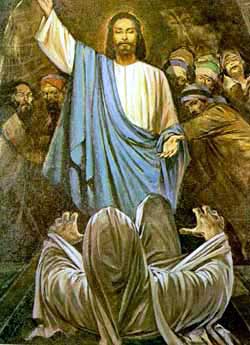
Image: Resurrection by Solomon RAJ, India
.

The Resurrection of Our Lord

The Prayer for Easter Evening

Almighty God, you give us the joy of celebrating our Lord's resurrection. Give us also the joys of life in your service, and bring us at last to the full joy of life eternal; through your Son, Jesus Christ our Lord, who lives and reigns with you and the Holy Spirit, one God, now and forever. Amen.


Image source: Empty Tomb, by He Qi, China.

Saturday, March 22, 2008

Tonight's Easter Vigil

The Easter Vigil, held tonight at 7:30, is one of my favorite services of the church year. At my home church, we gather outside for the lighting the New Fire, bless a new Paschal Candle, and slowly proceed--led by cantors singing "Light of Christ" with candles in our hands--into the still darkened sanctuary . As we go through the doors into the sanctuary, we are greeted with the smell of lilies. We pause at the back of the sanctuary to hear readings from the Old Testament and join the cantors in singing of more psalms. As we listen, we know that all is ready: the bread and wine, soon to be for us the Body and Blood of Christ, wait our arrival. Again in procession we move further into the sanctuary to offer prayers for those who will be baptized throughout Christendom, hear the story of the Resurrection, and begin the ancient Eucharistic Liturgy. As the most intensely beautiful liturgy in the Church's year, having prepared ourselves during Lent for this Day's celebration, we are eager to this year's first announcement that "Christ is risen!"

During the liturgy June and I will be in prayer for all of you who are trusting in the faithfulness of the Father who loves us in Christ. We will ask the Holy Spirit to bless you. And, if you have asked us to pray for you, we will offer our intercessions for you by name. We will especially remember those of you who have been praying with us, mornings and evenings, throughout the year.

Christ is risen! He is risen indeed.!

Friday, March 21, 2008

Holy Saturday: The Great Sabbath

I'm writing just a few minutes before three o'clock on Good Friday, and according to the Gospel accounts, it was at this time that Jesus, "God of God, very God of very God" (as the Nicene Creed says) died on the cross. Perhaps like me, on this Good Friday you have envisioned God in our flesh, Jesus, being taken down from the cross and carried on a bier to the tomb where hastily his friends are placing him on a stone slab before the Friday sun sets and the sabbath begins. In an hour or so, the tomb will be shut and sealed.

In my prayerbook, I'm asked to remember--with Christians everywhere--that this evening is Holy Saturday because tonight begins the day that Christ "rested" physically in the tomb. Anciently, it is also believed that it was on this day Our Lord performed in spirit the Harrowing of Hell and raised up to Paradise those held captive there.

Beginning this evening and nearly all of tomorrow's Saturday/Sabbath, I will be resting a good bit, simply waiting (sitting quietly outside if the weather is good, perhaps reading) for the day to pass so that on Saturday evening, June and I will, along with our daughter Chelsea, can drive up to Lexington for the 7:30 p.m. Easter Vigil, the first stirrings of Easter, the Day of the Resurrection of Our Lord. As I wait, I plan to listen to Henri Nouwen's wonderfully insightful talk on “The Spirituality of Waiting,” which you can read online, or hear via a recording of Nouwen himself. I owe this listening opportunity to Ben Witherington's comments in which he says,
During a difficult season in my Christian life, Henri Nouwen provided me with manna from heaven, water in a weary and dry place and guidance on spiritual formation that I still live out of. I would say he is certainly one of the greatest spiritual formation writers of any age. The picture on the left is from one of his books which deals both with slowing down and listening to God, and also being honest with God and waiting upon the Lord.

After thanking James Howell for the initial link to Nouwen, Witherington continues:

It will be worth your time [reading Nouwen]. "For those who wait in the Lord will renew their strength,They will mount up like eagles with wings of great length. They will run and not get weary, they will walk and not faint. Giving strength to the weary, and power to his saints."

Dona nobis pacem

I plan to to read Nouwen tomorrow. Perhaps you'd like to join me. In addition to praying the Daily Offices, I will also visit Daniel B. Clendinen's Journey with Jesus to read as my lectio divina Clendinen's commentary on the lectionary readings for the Feast of the Resurrection. Perhaps you too would like to visit Clendinen; that also will be well worth your time, your waiting time.

Monday, March 17, 2008

Entering Holy Week

Yesterday we received our palms. It's a tradition in many churches, my Lutheran parish among them, for those who waved their newly blessed palms in the procession to and through the church doors to take their palms home and place them behind icons, pictures, and crosses so that throughout the year, they may remember that on Passion Sunday, our Lord entered Jerusalem with the enthusiasm of his followers. Palm waving for Jesus, all of us discover, is fairly easy. Going with Jesus to the cross, however, is much more difficult, often dangerous. During the year, as the leaves on the palm branches dry up and sometimes turn brownish-green, we are reminded that beyond the enthusiasm, Jesus walked the Hard Road, the road He invites us to take with him. As we walk our way through this Holy Week, remembering day by day how Jesus shows us the Way, may our eyes be rivited on His commitment as He walks in front of us. May we look hard and long at the Way he chooses for Himself--and asks us to journey with him.

Friday, March 14, 2008

Our Lenten Psalmody Studies

Hats off to our Lenten psalter studies! Beginning last January 24, we met seven out of eight Lenten Thursdays so we might know how to sing the Psalter. While studying our way through six chapters of Cynthia Bourgeault’s Chanting the Psalms, we taught ourselves psalm tones and practiced chanting the Psalter in Evening Prayer. At last evening’s gathering, we took a good look at the Psalter for the Christian People and decided that we’d encourage ourselves to purchase copies so that when we come together as a group, we’ll have a common Psalter with which to sing to God. Based on “inclusive-language revision of the Psalter of The Book of Common Prayer 1979, this Psalter is very inexpensive (about $6.00 when purchased as “nearly new” from Amazon's new and used booksellers. Using this ecumenical psalter means that anyone from any Christian tradition, both at home and in our gatherings, can join us in our psalm-singing prayer life.

Special appreciations go out to all who came to our Thursday evening meetings at First Presbyterian Church, and especially all of you who traveled considerable distance on dark and often chilly nights to encourage one another! As we go forward into Holy Week, the Vigil of Easter, Eastertide, Pentecost, and the days afterward, may all of us remember one another in our prayers, especially in the evenings when we make intercessions for one another in the Church. For each one who came, shared, studied, learned, and prayed, our group is grateful to God for your presence and your prayers.

Wednesday, March 12, 2008

From Andy's Chapbook: Merton on humility

To the truly humble man the ordinary ways and customs and habits of men are not a matter for conflict. The saints do not get excited about the things that people eat and drink, wear on their bodies, or hang on the walls of their houses. To make conformity or non-conformity with others in these accidents a matter of life and death is to fill your interior life withconfusion and noise. Ignoring all this as indifferent, the humble man takes whatever there is in the world that helps him to find God and leaves the rest aside. He is able to see quite clearly that what is useful to him maybe useless for somebody else, and what helps others to be saints might ruin him. That is why humility brings with it a deep refinement of spirit, a peacefulness, a tact and a common sense without which there is no sane morality.

Merton, Thomas. New Seeds of Contemplation. (New Directions, 1961) 84-85.

Good news about Sister Judy!

Sister Judy's Benedictine sisters just sent this email update:

Just a quick note to let you know that Sr. Judy's surgery on her thyroid went well this morning. They only needed to take the right lobe and it looks benign. If things go as planned she will be home tomorrow. Thanks for your prayers!

That's wonderful news. Now we can all thank God that all went well!

Tuesday, March 11, 2008

March 13: our final Lenten Thursday evening meeting

On Thursday evening, 7:00, our little community of Daily Office pray-ers will meet at First Presbyterian Church. Stephen Locke will lead us in Evening Prayer. Before Evening Prayer, we will discuss what's new in our thinking about a Psalter to meet our needs. And we will practice singing the appointed psalms for the evening with this double tone that is beautiful and easy to sing. And--O yes!--this: on Monday evening Andy spoke with Wayne, one of the cantors who leads congregational psalm-singing during Sunday Eucharists at Faith Lutheran Church, and Wayne has agreed to come and visit us at the end of May when we'll have our annual picnic together at June and Andy's home. You'll really like Wayne! That's he in the center of the photograph.

Pray for Sister Judy

Sr. Judy (that's she, the second from the left) , for some of us our Oblate Director at The Monastery on Mt. Tabor, will be in Central Baptist Hospital on Wednesday and Thursday of this week for thyroid-related surgery. Please remember her in your prayers, perhaps by offering this intercession:

Lord Jesus Christ, by your patience in suffering you hallowed earthly pain and gave us the example of obedience to your Father's will. Please be with Sister Judy in her time of weakness and pain; sustain her by your grace, that her strength and courage may not fail; heal her according to your will; and help her always to live within your faithfulness to us. Be with all who love her, especially all her Benedictine sisters and most especially those at her monastery. In your love protect all of us us as we seek to do your will, sharing your divine hospitality with all whom we meet. Lord, in your mercy, hear our prayers.

Monday, March 10, 2008

A Pope whom many Christians remember with gratitude

On Wednesday, March 12, numerous Christian churches, notably the Roman Catholic, but also including many in the Protestant tradition (especially Lutherans and Episcopalians), will remember and give thanks to God for the life of Gregory the Great, Bishop of Rome, who died in 604 a.m. Remembering that he labored during an extraordiany dark time in the history of the Europe (and long before there were any serious divisions of the Church), do take time to read this short biography of his life and thank God for his tremendous witness to Christ.

As James E. Kiefer reminds us in his short biography of Gregory the Great,

English-speaking Christians will remember Gregory for sending a party of missionaries headed by Augustine of Canterbury (not to be confused with the more famous Augustine of Hippo) to preach the Gospel to the pagan Anglo-Saxon tribes that had invaded England and largely conquered or displaced the Celtic Christians previously living there. Gregory had originally hoped to go to England as a missionary himself, but was pressed into service elsewhere, first as apocrisiarius [a delegate or deputy; especially, the pope's nuncio or legate at Constantinople] and then as bishop of Rome. He accordingly sent others, but took an active interest in their work, writing numerous letters both to Augustine and his monks and to their English converts.

Gregory served the Christian church well, although he was not perfect, (who among us is?).

As an aside: in my chapbook, I've placed this quotation, attributed to Gregory by Aquinas in his Catena Aurea: "The highest, the only proof of love, is to love our adversary."

After you read about him, you may wish to offer this prayer to God:

Almighty and merciful God, who raised up Gregory of Rome to Be a servant of the servants of God, and inspired him to send missionaries to preach the Gospel to the English people: Preserve in your Church the catholic and apostolic faith they taught, that your people, being fruitful in every good work, may receive the crown of glory that never fades away; through Jesus Christ our Lord, who lives and reigns with you and the Holy Spirit, one God, for ever and ever.

More from Andy's Chapbook: Lewis on Temptation

I know all about the despair of overcoming chronic temptations. It is not serious provided self-offended petulance, annoyance at breaking records, impatience, etc. doesn’t get the upper hand. No amount of falls will really undo us if we keep on picking ourselves up each time. We shall of course be v. muddy and tattered children by the time we reach home. But the bathrooms are all ready, the towels put out, & the clean clothes are in the airing cupboard. The only fatal thing is to lose one’s temper and give it up. It is when we notice the dirt that God is most present to us: it is the v. sign of His presence.

C.S. Lewis, letter to Mary Neylan, The Collected Letters of C.S. Lewis, Vol. II, ed. Water Hooper (San Francisco: Harper, 2004), 507.

Sunday, March 09, 2008

From Andy's Chapbook

I'm always on the lookout for quotations that I want to copy into my chapbook. I find them in journals and magazines, newspapers, books and commentaries, roadside graffiti, brochures, advertisements, comic strips, the lives of the saints, Internet postings, postcards--in short, from anything written (and sometimes spoken). When I find something that I want to chew on, I scribble it into a little leather chapbook, usually with an old-fashioned fountain pen; and then--now and then--I turn back on the pages and read what I thought was good and worth preserving for a rainy spiritual day. So tonight I thought I might start to share some of them with you periodically. Here's one:

Truth rises from the silence of being to the quiet tremendous presence of the Word. Then, sinking again into silence, the truth of words bears us down into the silence of God. Or rather God rises up out of the sea like a treasure in the waves, and when language recedes His brightness remains on the shores of our own being.

From Thomas Merton, Thoughts In Solitude (New York: Farrar, Straus and Giroux, 1956) 86.


Preparing for Next Sunday, Palm Sunday or Passion Sunday

Here are the lectionary readings for Palm Sunday, March 16:

Isaiah 50:4-9a
Psalm 31:9–16
Philippians 2:5–11
Matthew 26:14–27:66 or Matthew 27:11–54

Spend some time with them. And again, as ususal, here is Daniel B. Clendenin's commentary, well worth a good reading

Image Source: Corinne Vonaesch, 2001. L'entrée de Jésus a Jérusalem,

Tuesday, March 04, 2008

Leslie doing fine!

Yesterday Leslie wrote to say that the surgery on the back of her neck went well. The procedure, she says, was "just at two hours"; the surgeon worked on four nerves so that in the future they won't produce nearly as much pain. But for now, Leslie says that she's "rather sore and brused, and will feel worse before [she] gets better . . . . With luck, [she] should be back at work on Wednesday. Right now it's ice packs, warm compresses, tea and toast, percet and asprin. " In closing, she sends her "love to all." And we send ours to you, Leslie!

Pray without Ceasing

Have you ever wondered what St. Paul means when he encourages us to "Pray without ceasing" (I Thess. 5.17)? Consider this understanding of that imperative by an Orthdox writer:
Usually in the Holy Scriptures, the word always is used in the sense of "often." For instance, "The priests went always into the first tabernacle at certain fixed hours, not that they went there unceasingly by day and by night; they went often, but not uninterruptedly." Even if the priests were all the time in church, keeping alight the fire which came from heaven, and adding fuel to it so that it should not go out, they were not doing this all at the same time, but by turns, as we see from St. Zacharias: "He executed the priest's office before God in the order of his course' (Luke 1. 8). One should think in the same way about prayer, which the Apostle ordains to bedone unceasingly, for it is impossible for man to remain in prayer day and night without interruption. After all, time is also needed for other things, for necessary cares in the administration of one's house; we need time for working, time for talking, time for eating and drinking, time for rest and sleep. How is it possible to pray unceasingly except by praying often? But oft-repeated prayer may be considered unceasing prayer.

Source: The Art of Prayer: An Orthodox Anthology. Compiled by Igumen Chariton of Valamo. Edited by Timothy Ware. (Chatham, Kent: Machays PLC, 1997), 49.

Monday, March 03, 2008

Praying for Haiti

As some of you may know, I have a special love for the people of Haiti, especially those living in and around the village of Ranquitte, located back in the mountains of upper north-eastern Haiti.

In April four of us from central Kentucky (Dr. Robert McMorrow, along with two Lutheran pastors, Ron Luckey and Barry Neece, and I) will be making a trip (April 10-17) to build a home for "the poorest of the poor," in our hemisphere. If you'd like to look at some photographs of our last trip, made in October, 2007, visit Faith Lutheran Church as follow the links. If you'd like to join us, let me know,

Praying Daily meets again on Thursday, March 6


Our community of Daily Office people will meet again this Thursday, March 6, 7:00 p.m. at First Presbyterian Church in the Parlor Room. Inasmuch as we concluded our discussion last Thursday with considerable talk about a common Psalter for us, Leslie Ferris sends the following list of Psalters for our consideration:

1. A New Metrical Psalter by Christopher Webber (Lectionary Psalms)
2. Hymntune Psalter by Daw & Hackett Vol. 1 & Vol. 2 (Lectionary Psalms)
3. Anglican Chant Psalter Alec Wyton - (all 150 Psalms)
4. Plainsong Psalter - James Litton - (all 150 Psalms)

If you have a Psalter you'd like for us to look over, please bring it to our "show and tell." By way of support for our discussion, we'll use Chapter 6, "Psaltersand Sourcebooks," in Cynthia Bourgeault's Chanting the Psalms, as our text for study. We'll begin Evening Prayer at 8:00 p.m. After our March 6 meeting, we have one more Lenten gathering on March 13.

Image Source: http://www.artfund.org/images/artwork/2004108_1.jpg

The Lectionary Readings for Next Sunday, March 7, The Fifth in Lent, 2008

As promised, here is where to go on your Journey with Jesus as you prepare to listen to, contemplate, and live by the Word in next Sunday's lectionary readings: Ezekiel 37:1–14; Psalm 130; Romans 8:6–11; the Holy Gospel to be read for next Sunday is the story of the raising of Lazarus from death. You will appreciate reading Daniel B. Clendenin's commentary.

Sunday, March 02, 2008

The Collect for the Fourth Sunday in Lent

Grant, we beseech you, almighty God, that we, who for our evil deeds deserve to be punished, by the comfort of your grace may mercifully be set free; through your Son Jesus Christ our Lord, who lives and reigns with you and the Holy Spirit, one God, now and for ever.

Source: The Gregorian Sacramentary (Rome, 8th cent. mss.); qtd. The Daily Prayer of the Church, 984.

Two Icons to Share

On Friday I received a large wooden crate containing two icons that June and I had commissioned as gifts to The Church of the Good Shepherd (Episcopal) in Covington, GA. On Saturday morning I photographed them so that you might enjoy looking at them. And tomorrow I will re-crate them and send them on to Fr. Tim Graham, the rector of The Church of the Good Shepherd.

The icon on the left is called "Theotokos and Child"; the icon on the right is "The Good Shepherd." The icons will be installed in the narthex of a new church sanctuary and will be blessed at the consecration of the building by the Bishop of Atlanta on April 20.


Both icons were "written" by Mel Ahlborn, about whom you may wish to learn more. You may also wish to listen to an interview with Mel Ahlborn in a RealAudio slide presentation.

Saturday, March 01, 2008

The Marvel of the Psalter

Among all the books, the Psalter has certainly a very special grace, a choiceness of quality well worthy to be pondered; for, besides the characteristics which it shares with others, it has this peculiar marvel of its own, that within it are represented and portrayed in all their great variety the movements of the human soul. It is like a picture, in which you see yourself portrayed and, seeing, may understand and consequently form yourself upon the pattern given. Elsewhere in the Bible you read only that the Law commands this or that to be done, you listen to the Prophets to learn about the Saviour's coming or you turn to the historical books to learn the doings of the kings and holy men; but in the Psalter, besides these things, you learn about yourself. You find depicted in it all the movements of your soul, all its changes, its ups and down, its failures and recoveries.

From St. Athansius, Letter to Marcellinus (included in an edition of On the Incarnation, St. Vladimir's Press, 1998); qtd. Lutheran Forum, 37:2 (March 2008).