Tuesday, January 29, 2008

Stephan Locke sends us this terrific announcement:

Annual Men’s Group Shrove Tuesday Pancake Dinner

The pancake supper will be on Feb 5th, 2008, from 5:30 pm to 8:00 pm in the Parish Hall at the Church of Our Saviour. Suggested donation is $3 per person, $5 per couple, $7 per family. (Feel free to donate more, as all collected funds will go to Home Meals Delivery, a wonderful community outreach that Our Saviour supports.)
Madison County Episcopalian and Lutherans Host Joint Services and Photo Exhibits for Lent

Members of Madison County’s Episcopal Church of Our Saviour and St. Thomas Lutheran Church will join together to observe the 40 days of Lent beginning with an Ash Wednesday service at 7 p.m. on Feb. 6 at St. Thomas at 1285 Barnes Mill Road, Richmond. Everyone is welcome to participate in the service.

Each Wednesday during Lent, members of both congregations will gather at the Church of Our Saviour at 2323 Lexington Rd., Richmond, at 6 p.m. for a light meal and Taize services. The dates are Feb. 13, 20 and 27 and March 5, 12, and 19. A Taize service uses meditative music from the Taize community in France. The Community is made up of over a hundred brothers from Catholic and Protestant backgrounds, coming from more than 25 nations. Visitors to the meal and the service are most welcome.

This year, as part of the combined Lenten observance, the two churches are sponsoring two photography exhibits. The first will be on Ash Wednesday with a theme of “Dust and Ashes.” All photographers are encouraged to bring a framed and ready to hang 8 x 10 black and white photo to St. Thomas as you come to the service. If you cannot attend the service, bring your photo by on or before Feb. 6.

The second exhibit will be at the end of the Lenten season. The theme will be “Resurrection.” Photos for this exhibit can be color or black and white. Everyone is welcome to submit an 8 x 10 framed photo for either exhibit.

For more information, contact the Rev. Birch Rambo at (859) 623-1226 or Pastor Andy Rutrough at (859) 623-7254.

Monday, January 28, 2008

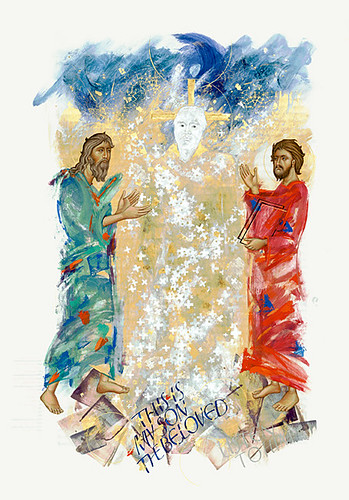
This next Sunday, February 3, is for many churches and Christians the celebration of the Feast of the Transfiguration, the climax of Epiphanytide, the Sunday before we begin the Season of Lent. If you wish to prepare yourself for worship on Transfiguration Sunday, consider visiting Journey with Jesus, a weekly essay on the Biblical lectionary by Daniel B. Clendenin; it's a visit well worth the pilgrimage.

[Image source: http://static.flickr.com/35/104435614_6328e7bf69.jpg from The Saint John's Bible]
This afternoon June and I were warmly greeted by everyone in Nancy Long's prayer group which is studying St. Benedict's Toolbox by Jane Tomaine. The discussion was lively, full of good questions, and Nancy gave June and me considerable opportunity to talk about the Daily Office and the ecumenical Monastery of Mt. Tabor. Several in the group would like to explore the use of a good prayerbook, and so I'd like to ask that any of you who still have copies of Robert Jenson's Daily Prayer: A Little Book for Saying the Daily Office--and perhaps a copy of the CD that accompanies it--to bring those copies to our Thursday evening on January 31 so that we can share them with newly interested friends. As you well remember, Benson's introduction to the Daily Office helped many of us a year ago get our first taste of "fixed hour" daily prayer. Let's pass on the blessing!

Saturday, January 26, 2008

Just a reminder: if you're interested in praying at more or less "fixed times" during the day (for example, morning and evening) and don't know what resources are available for you, simply get in touch with us (easily by first opening the comments link and typing in a observation, question, or request and then by publishing your comment either to the blog or by email to me). Having suggestions for all Christians in all denominations and traditions, we'll respond quickly to your needs, concerns, and questions. You'll be surprised at what's available for your Christian journey!
Yesterday our mail carrier delivered Dennis Okholm's Monk Habits for Everyday People: Benedictine Spirituality for Protestants. Sent as a suggestion by Sr. Judy Yunker, it's a terrific book. June and I began reading it last evening, and I don't think we'll put it down until we finish it (and then I suspect we'll pick it up again and again). It might be another option for our Lenten reading. Here's a quotation from one reviewer on http://www.amazon.com/ who gives it five stars:

It's rare to find find a book that does so many things so well. It is interesting, personal, and engaging. It is thoughtful and well-written. And it is full to the brim with spiritual insights. Read a bit each day, sip it alongside your morning cup of coffee, savor each insight, and you'll find your life just gets better and better. A delight.

I'll bring our copy to our next meeting on Thursday, January 31, to that you take a look for yourself.
This morning I've added two links to our recommended sites to visit: Thinking Faith: The Online Journal of the British Jesuits and their Pray as You Go, a Monday-through-Friday broadcast of the Daily Office, available for online listening or as a MP3 or iTunes downloadable podcast. Take a look and see if one or both of these might be useful in the formation of your Christian thought and prayer life.

Friday, January 25, 2008

January 25: The Conversion of St. Paul Day

O God, by the preaching of your apostle Paul you have caused the light of the Gospel to shine throughout the world: Grant, we pray, that we, having his wonderful conversion in remembrance, may show ourselves thankful to you by following his holy teaching; through Jesus Christ our Lord, who lives and reigns with you, in the unity of the Holy Spirit, one God, now and for ever. Amen.
[Image: The Conversion of St. Paul, 1600-1601; Oil on canvas, cm 230 x 165;Cerasi Chapel, Santa Maria del Popola, Rome]
Last night our Daily Office community met at 7:00 at First Presbyterian Church in Richmond, Kentucky, to learn how to sing the psalms. Using Cynthia Bourgeault's Chanting the Psalms and its accompanying CD, Mason helped us work through Chapters 7 and 8. We had the great joy of welcoming Nancy Long and Mary Ann Faughn as newcomers, and we hope they will return to be with us in prayer for many years. At 8:00 we prayed Evening Prayer and, for the first time in our community's experience we sang a psalm and canticle at prayer: part of Psalm 119 and the Song of Mary. After the blessing, Stephen Locke showed us copies of the Songs & Prayers from Taize he has available for us to purchase at very low cost; we will find out more about them next week. We also briefly took note of Frederica Matthewes-Green's First Fruits of Prayer: A Forty-Day Journey through the Ancient Great Canon as a possible Lenten book for us to read and discuss. It was so good to see everyone again, especially Jim Ferris who traveled so far on a very chilly night to be with us. We'll meet again next Thursday, January 31, to finish Chapter 8 and move on to Chapter 9, singing as we go. And our heartfelt thanks to Grace and First Presbyterian Church who made it possible for us to meet in their lovely Parlor/Library!

Monday, January 21, 2008

Sr. Judy Yunker sends a cheery "Hello!" and writes to bring us up-to-date about goings-on at the ecumenical Monastery of Mt. Tabor. You may wish to visit the monastery's brand new website; it's full of information and looks spiffy! Sr. Judy says,

We had goal setting, discernment and election this weekend. I was elected the first Prioress of the Ecumenical Community. At the end of February. we have a Lutheran woman from North Carolina, coming up to begin her pre-entry six months in the area. Also at the end of February, a woman from New York is coming for her second visit in her discernment about joining the community. God is pretty good as a vocation recruitment. More later.

When I wrote to ask Sr. Judy about the possibility of a Lenten retreat, she wrote back asking if we prefer weekends or some days during the week. She says that they only weekend available in Lent is March 8-9. When we get together on Thursday evening, let's chat a bit about the possibility of a Lenten retreat.

O, yes, by the way--Sr. Judy also sends along this recommendation:
Here is the title of a new book on Benedictine Spirituality, Monk Habits for Everyday People: Benedictine Spirituality for Protestants (Brazos Press, 2007) by Rev. Dennis Okhlom, a Presbyterian minister who teaches theology at Azusa Pacific
University and is co-pastor of St. Andrew's Church in Newport Beach, California.

Our thanks goes out to Sr. Judy for staying in touch with us, for her book recommendation, and we congratulate her on being elected the first Prioress of the community. Let's all be sure, whenever possible, to include everyone at the monastery in our prayers and intercessions.


[Image source: http://www.mtabor.com/]

Saturday, January 19, 2008

On Monday afternoons at 1:00, a group gathers at First Christian Church for prayer. Beginning Monday, January 21, they will be using St. Benedict's Toolbox by Jane Tomaine as a study and practice guide. Each week participants will hear a synopsis of a chapter of the book and then each one will choose a tool or tools (prayer/spiritual growth exercises) he/she wishes to begin work on during the week. The following week, there will be a check-in time to see how the exercises are going. Group members will also share prayer concerns, what's going on in their lives at the moment, and how their prayer life is progressing. The group meets for one hour and all are welcome. For more information, contact Nancy Long 623-4383 or 859-979-4585.

Thursday, January 17, 2008

Cynthia Bourgeault's Chanting the Psalms, Chapter 3: Psalmody as Christian Yoga (27-37)

For some folks this chapter will be the most provocative because it suggests that singing the psalms does something unexpectedly unusual.

Bourgeault begins by reminding that about a decade ago “a CD called Chant, recorded at an obscure Benedictine monastery in Spain, suddenly made it to the top of the pop charts”:

For many contemporary North Americans, it was their first clue that Christianity actually had a tradition of sacred chanting, let alone one of such unparalleled beauty and spiritual intensity. As the CD spun its magic, many marveled at what they were hearing and wondered what spiritual practices or altered states of consciousness could have created such sublimity. (28)

The monks who sang Chant were simply doing what Benedictines have been doing for 1,500 years; they were singing the psalms to Gregorian tones. Bourgeault suggests that by singing the psalms, day in and day out, the monks were blessing themselves (or being blessed by God)with a profound spirit of contemplative peace and mindfulness. This deep inner peace, created by the singing of the psalms, affected everything they did—their thoughts and work—throughout the day. To support her contention, Bourgeaut tells this story about Alfred Tomatis, a famous eye and nose specialist:


In a monastery in southern France some forty years ago, he was called in for a consultation because the monks had mysteriously fallen ill. Almost every kind of remedy had been tried—medication, diet, more exercise or less exercise, rest—but the malaise still lingered. Finally searching more deeply for a cause, Tomatis discovered that not long before, the abbot had joined the modern trend of scrapping the Gregorian chant and diminishing the length of time the monks spent chanting the Divine Office. Tomatis called for the chant to be restored, and almost instantly, the monks started to revive. It turned out that their beautiful Romanesque chapel was actually a perfectly tuned reverberating bowl, allowing the monks to receive energy—actual physical sustenance—directly from the vibrations of the chant. Removing it had left them malnourished. (30)

From this observation, Bourgeault proceeds to suggest that singing the psalms does indeed provide us with some very personal benefits that we do not usually associate with our use of Scripture. Psalm-singing can be a form of Christian yoga in that it graces us with a deep sense of peace because such chanting immerses us in “the creative power of the universe.” To make music, Bourgeault reminds us that we must work—in our bodies, minds, and spirits—with “the four elements out of which the earth was fashioned and through which all spiritual transformation takes place” (32):

(1) breath (the Greek word behind our word for Spirit)
(2) tone (that is, vibration, Voice, or “Word of God”)
(3) intentionality (what the words mean to us personally)
(4) community (learning to fit in with others)

Now this may sound a bit New Age-ish, I nevertheless think that Bourgeault is on to something. Many forms and kinds of music provide us with experiences of immersion, being drawn into a mystery greater than ourselves. Frankly it happens to me quite often during hymn singing and during the singing of the Eucharistic liturgy at Faith Lutheran Church in Lexington, Kentucky. At other times the quiet power of a voice in folk-singing overwhelms me. Certain forms of jazz mesmerize me. At times I fall into what some call “the zone” when singing in a choir. And, yes, the singing of psalms, especially from memory, often places me in a Place that’s hard to describe, nearly outside myself as my breathing becomes sustained and rhythmic, as the Word of God flows over and out of me, as I find myself being interpreted and interpreting, as I join others in lamentation, praise, and communal joy.

Bourgeault concludes the chapter by describing some of her experiences with “Christian mantric chanting” that gave her a “taste of oneness” with God, the universe, and others. In my own experience, I think of those times when the singing of Taize songs invites me toward that One who is the All in All.

This third chapter is well worth a good quiet read. Read well, it may introduce you to some quite wonderful about psalm-singing: a union with “the hearts of all human beings in a mutual compassion that makes a strength of our diversity and creates safety and healing for our planet” (37).

Wednesday, January 16, 2008

Cynthia Bourgeault's Chanting the Psalms, Chapter 2: Early Monastic Psalmody (17-26)

In Chapter 2 Bourgeault traces how the Church, especially in monasteries, sang the psalms. Noting how important it was for early Christians to get as close to Jesus as possible, she emphasizes that first-generation Christians sang the psalms primarily because Jesus sang the psalms. The early Christians imitated Jesus and sang psalms in order to remember and model their lives after him.

For two centuries Christians, persecuted and meeting in house churches, confessed their faith, came together to break bread, often died as martyrs, and sang the psalms which Jesus sang. Then something happened in the fourth century that changed the landscape entirely. In 313 A.D. the Emperor Constantine legalized Christianity so that Christians were able to come out of the catacombs and stand in respectable daylight. ”Suddenly Christianity found itself preoccupied with building basilicas, hammering out creeds, creating elaborate liturgical ceremonies, and expressing its newfound sense of “the reign of Christ” through vestments and trappings of imperial royalty” (19). The change in spiritual atmosphere, tone, and commitment was dramatic. Almost overnight Christianity lost its countercultural edge and, having become the only legitimate religion of the Empire, began to luxuriate in wealth and privilege. Christianity became culturally acceptable; people by the droves packed the new church buildings.

Many Christians came to the conclusion that something powerful—-the imitation of Christ!-—was in danger of being lost. As a consequence, thousands of Christians fled the big city “mega-churches” and fled into the deserts of Syria and Egypt, first in trickles, then in droves. They took the psalms with them. “These spiritual pioneers became known collectively as the Desert Fathers and Mothers”(19). Developing a variety of monastic communities, they lived "as hermits or in small clusters known as sketes” and/or eventually “found their way to large monastic complexes where hundred or even thousands of monks banded together in quasi-military style. But whether solitary or communal, the monks all seemed to root their prayer practice in the words Jesus used [that is, the psalms]” (19.)

Learning to sing the psalms from memory, they sang the hymns of Jesus throughout the day as they worked and worshipped. Many spent their energy in ceaseless prayer by repeating over and over again a versicle from Psalm 70 as “a means of achieving continuous attention in prayer: ‘O God, come to my assistance; O Lord, make haste to help me’” (20).

As second wave of psalm-singing occurred a hundred years later. In the sixth century, after the disastrous fall of Rome that ushered in the so-called Dark Ages, Benedict of Nursia worked to develop Christ-centered monastic communities throughout Europe. These Benedictine communities were Christian sanctuaries that preserved and institutionalized the singing of the psalms. In his Rule Benedict provided a day-by-day scheduling of work, worship, and opportunities for hearing the Word of God that profoundly renewed the way Christians prayed and sang the psalms. It’s at this time, Bourgeault rightly notes, that “the Divine Office makes its official debut” (22).

The monastic day was full of psalm-singing. Traditionally things started in the middle of the night (about two or three a.m.) with the service (or office/work) of vigils; thereafter seven other office during the rest of day guided the community in work and worship: lauds (at early dawn); prime (6:00); terce (9:00); sext (noon); none (3:00) vespers (sunset), and compline (just before retiring). Within a week’s time, the community sang all 150 psalms.

Concluding this chapter, Bourgeault describes her experiences at Mount Saviour Monastery in upstate New York, She rightly tells us that in most modern monasteries, psalm-singing is not quite so extensive, “but the ideal remains in place” 23).

In fact, if here I may add this note to Bourgeault’s Chapter Two, you and I can go to the Abbey of Gethsemane in Trappist, Kentucky, for a retreat with the monks and there find the ancient praying of the psalms still in tact.

Bourgeault concludes the chapter by describing the monks’ work (office) as “bi-axial,” that is cross-shaped (+). As they live with each other (horizontally, so to speak), they also live in attentive awareness of God (vertically). In large measure it’s psalm-singing throughout the day that makes it possible for them live bi-axially. “Reaffirming the desert understanding that psalmody is in essence mindfulness prayer, [Benedict wrote] in the Rule, ‘Let us consider how we ought to behave in the presence of God and his angels, and let us stand to sing the psalms in such a way that our minds are in harmony with our voice” (26). Bourgeault concludes by saying that Benedict’s words are “a good reminder, as timely now as it was fifteen hundred years ago. And just as difficult.”

Tuesday, January 15, 2008

In an earlier posting I indicated that I’d try to provide you with some chapter summaries of Cynthia Bourgeault’s Chanting the Psalms (hereafter CP).

Because most of us in our group are primarily looking forward to learning how to sing or chant the Psalms, it may be best if we don’t spend too much on Part One. Part Two: Chanting the Psalms is where the rubber will hit the road for us. For that reason, if you have the book, you may want simply to look over Part One while I summarize it for you in the weeks ahead. Otherwise, simply read the summaries as they come to you and be well prepared to learn how to sing the psalms!

This means that on January 24, we will go almost immediately to Part Two, focusing on Chapter 7: “Finding Your Voice” and Chapter 8” “Suzuki Psalmody.” After we spend about an hour discussing a chapter or two, listening to the CD that accompanies CP, and practicing chanting ourselves, then before or at 8:00, we’ll decide what to do for the next week, do Evening Prayer together, and then give one another a big hug, hoping to see each other on January 31, where we’ll pick up where we left off. All this means that we do not want to rush anything or set predetermined goals; we’ll feel and sing our way into singing the psalms and see what happens.

Let's get started by taking a preliminary look at what happens in CP’s Part One: “The Hidden Wisdom of Psalmody,” This section has six chapters. In the first, Bourgeault explores the psalms’ historical settings; in the second she traces how the Church has sung the psalms down through the centuries; her third chapter likens singing the psalms to Christian “yoga"; in chapter four Bourgeault describes the psalms’ usefulness for personal and communal growth; in five she suggests that the psalms help us develop a “unitive imagination"; and finally in six, she shows us some of the books and psalters we have for our exploration into psalm singing.

Chapter 1: The Hidden Wisdom of Psalmody

This is the only chapter in which you get what is anything like a conventional introduction to the book of Psalms. “When it comes to the psalms,” Bourgeault is convinced that “we are standing on some of the most ancient holy ground in our common Judeo-Christian heritage” (9). When chanting, we sing what Jesus and his ancestors were singing, depending on the psalm, for well over a thousand years. While some psalms may well predate King David (c. 1000 BC), “the bulk of the psalms” are thought to have been composed between 800-200 BC, a concentration of centuries which many historians call “the axial period,” a time when human consciousness underwent a world-wide transition from global identity (membership in a tribe) to emergent consciousness of an individual identity (11-12). In short, during the axial period the ancient emphasis on the pronouns we, us, and our opens to a new sense of I, me, and mine. Importantly, this emergent “individual expressiveness of the psalms in not the same as the rugged individualism of the nineteenth-century romantic poets, such as Keats or Byron” (16), for whoever says “I,” “my,” and “mine” in the psalms never sings apart from his people, his homeland, his community, and the memory of his mothers and fathers. In the psalms the individual is always in the midst of his people, God’s chosen people.

That, in summary, is what Bourgeault wants to emphasize in Chapter 1. I’ll try to get the summary of Chapter 2, “Early Monastic Psalmody,” out to you in a day or so.

Learning to chant the psalms, --Andy

Monday, January 14, 2008

When the pre-dawn sky is heavily overcast as it is this morning, one of the small pleasures I sometimes miss is seeing the stars an hour or so before the first indications of sunrise. So too this morning. In the spring, summer, and fall, after making coffee and before settling in for the morning quiet, I usually open the back door, step out, and look up to the sky. Because my neighborhood, not quite in the city and somewhat out in the country, has no street lights, I can frequently see the pre-dawn night canopy, that vast net of pin-hole lights we call the stars, twinkling overhead. Standing there, I sometimes feel small, almost infinitely small. But this morning, when I opened the back door and felt the chill, there was nothing to be seen.

I thought about the "unseen" last evening at Eucharist when we said the Creed: We believe in one God, the Father, the Almighty, maker of heaven and earth, of all that is, seen and unseen.

It was at saying the word unseen, that I remembered the image that Sr. Marlene Mertke, my Benedictine friend, sent me by email earlier yesterday morning: the image of the so-called "unseen" image of "beautiful nearby spiral galaxy IC 342" The astronomers at NASA tell us that "a sprawling island universe, IC 342 would be a prominent galaxy in our night sky, but it is almost hidden from view behind the veil of stars, gas and dust clouds in the plane of our Milky Way galaxy." The image of IC342 I saw Sunday morning had quite honestly lingered with me all day long yesterday, and in the evening during the Creed I confess I let myself see it again for a few seconds. Isn't it true that often what it's what we don't see, the Unseen, that every now and then breaks through so that our benighted lives take on new meaning? Earlier, before the Creed, when Pastor Luckey read the story of Jesus' baptism, I heard Matthew say that when Jesus "came up out of the water, then heaven was opened to him, and then the Spirit of God coming down like a dove and lighting on him." The Unseen came "like a dove" and perched on his shoulder, perhaps his arm or head. We see what Jesus saw--the Spirit of God; and we hear the Unseen Father say, "This is my own dear Son with whom I am well pleased." At the baptism of Jesus, we are watching and hearing an Epiphany of the Holy Trinity--Father, Son, and Spirit. And at our own baptisms we enter the same Epiphany as we are placed into the Name and Presence of the Father, and of the Son, and of the Holy Spirit. At the baptism of Jesus and within our baptisms God manifests Himself, and we, like Jesus, hear that we are his beloved children. In our prayers we say, "Glory to the Father and to the Son and to the Holy Spirit." We sometimes make the sign of the cross and in doing so place ourselves within the protection of the Holy Trinity. With the exchange of these blessings--from God and to God--in baptism and prayer, we come out of the waters and minister to the Father's world, seen and unseen, just like Jesus in the power of the Spirit.

I've often wondered what it must be like to see with eyes of Jesus, to "have the mind of Christ." Sometimes in the morning when I can see the stars, I imagine that I get a bit of a glimpse. This morning I want to thank Sister Marlene for sending me the picture of IC 342. And I want to thank Matthew for helping me see what Jesus, John, and the crowd saw--Almighty God, seen and unseen.

As a complement to NASA's image, Daniel B. Glendenin sends this Monday morning poem by Edwina Gateley:

Let Your God Love You

Be silent.
Be still.
Alone.
Empty
Before your God.
Say nothing.
Ask nothing.
Be silent.
Be still.
Let your God look upon you.
That is all.
God knows.
God understands.
God loves you
With an enormous love,
And only wants
To look upon you
With that love.
Quiet.
Still.
Be.
Let your God—
Love you.

[Image Source: http://antwrp.gsfc.nasa.gov/apod/archivepix.html]

Thursday, January 10, 2008

A few prefatory words about Cynthia Bourgeault’s Chanting the Psalms

Inasmuch as our Richmond, Kentucky, ecumenical prayer group will be meeting in January on the 24th and perhaps into February and March, to study and discuss Bourgeault’s Chanting the Psalms (hereafter CP), it may be helpful if we prepare ourselves by previewing and summarizing CP as we get ready to continue supporting one another’s prayer life.

CP’s “Table of Contents” indicates that the book has three parts with eighteen chapters. Part One with its subtitle, “The Hidden Wisdom of Psalmody,” consists of six chapters that give us some psalmic history, reasons for chanting the psalms, and resources for learning how to sing:

1. The Psalms of Ancient Israel
2. Early Monastic Psalmody
3. Psalmody as Christian Yoga
4. The Psalms as Psychological Tools
5. The Psalms as Soul Music
6. Psalters and Sourcebooks

Part Two, “Chanting the Psalms,” moves us incrementally from very simple chanting to and through a whole range of chanting options:

7. Finding Your Voice
8. Suzuki Psalmody
9. Reading Simple Psalm Notation
10. The Wide World of Antiphons
11. Reading Gregorian Notation
12. Customizing Your Psalmody
14. Developing Your Own Daily Office

Part Three, “Creative Adaptations,” gives us five chapters that take us on a global trip to a variety of communities who have developed their own distinctive ways of chanting the psalms:

15. Is There Chanting beyond the Psalms?
16. Taize Chant
17. Songs of the Presence
18. Iona Chant and Gouzes Chant
19. Dancing before the Ark

CP concludes with a good collection of notes, a helpful glossary, useful bibliography, and a list of selected musical resources. Importantly, Bourgeault’s CP comes with an “Instructional CD.” While driving around town, I have listened to the CD several times and am convinced that we’ll find it exceptionally helpful. I have not, however, read CP in its entirety and therefore you’ll have the benefit of following along as I tell you about my reading experience of the book itself.

Mason and I have upon occasion sat down together and tried to sing the day’s designated psalms for Morning Prayer, and as a tad off-key as we were at times, we found chanting entirely do-able. Just why we wanted to sing the psalms is something that Bourgeault’s CP will help us articulate.

One final important note: Bourgeault makes it quite clear that none of us has to be a good singer in order to chant the psalms. Each of us and all of us together can do it. As Bourgeault emphasizes the ordinariness and universality of chanting the psalms, I like to think that if we had heard Jesus and his disciples and/or the early Christians singing and chanting the psalms, as they often did --see the gospels [Mt 22:43, 26:30; Mk 14:26], Acts [2:25, 4:25], Paul [Rom 4:6] and other letters [James 5:13, Col 3:16; Eph 5:19], all of which attest to the singing psalms as noted in the New Testament)--I imagine that they might well have sounded just like us! Let’s join their company!

For the next few weeks, I’ll try to write a summaries of the chapters and send them out in advance of our meetings. And, of course, I hope to see as many of you as possible on the 24th of January at First Presbyterian Church, 7:00 p.m., in the Library/Parlor. If you want to purchase the book in advance, you can order Chanting the Psalms from http://www.amazon.com. The cost of a new copy is $12.89; used copies are available from $8.98. And if you don't wish to buy the book, that's just fine! I'll provide good summaries of the book at our meetings and online as we go along.

[Image Source: Psalm 110 "The Lord said unto my lord. " Block print by Charles Knowles. In The Psalm Book of Charles Knowles (New York: The Viking Press and Pinnacle Press, Inc. 1959, 1962).

Wednesday, January 09, 2008

January 10: William Laud, Archbishop of Canterbury, 1645

Tomorrow is one of those days I'm not always quite sure what to do with because William Laud is not one of my favorite saints; in fact, when teaching seventeenth-century English literature, I found it necessary to explain with some sorrow his activities in the notorious Star Chamber. Laud, you see, found it necessary to inflict physical and spiritual pain on many whom we consider Christians, some as saints and martyrs. Nevertheless, in spite of my apprehensions, the Church has thought it all right to place his name in our January commemorations and prayer life. What to do? I find that Sam Portaro in his Brightest and Best: A Companion to the Lesser Feasts and Fasts (Cambridge: Cowley, 1998) puts the case for Laud's inclusion rather well:

How are we to commemorate one of the key figures in the terrible works of the Star Chamber--that instrument of torture employed in the name of religion--in the season of the Star of Bethlehem, the guiding light of God's Epiphany? What are we to think of William Laud, religious advisor to Charles I, whose attitudes toward the practice of religion cost him and his monarchs their heads?

Do not think that I have come to bring peace to the earth; I have not come to bring peace, but a sword. For I have come to set a man against his father, and a daughter against her mother, and a daughter-in-law against her mother-in-law; and one's foes will be members of one's own household. (Matthew 10:34-36)

In that difficult saying Jesus addresses what many of us know to be natural enmities: father and son, mother and daughter, in-law and in-law. The common element uniting these tensions is that each is an enmity rooted in divergent expectations. The familiarity that breeds the hottest contempt is the familiar (or familial) relationship that surprises us by doing or being something suddenly unfamiliar.

The failure of the daughter-in-law to be like the mother-in-law (for the son-in-law like the father-in-law) breeds the embittered opinion that one's child has picked a loser. And whether it be without family of origin, the family of our baptismal birth call the church, or what generic family named the human race, we are ill-prepared and ill-tempered when confronted by those who diverge from our expectations. Some of our worst tantrums can be attributed to our anger at being unpleasantly surprised, our anger at being crossed by someone whose individuality conflicts with our own.

The discipline exacted upon the child, says the author of the letter to the Hebrews, is to endure the trails of such challenges and to learn how to balance one's own self with and within larger communities of equally independent selves. Indeed, the struggle to reconcile our differences, to take such surprises in stride, is the sign of our legitimacy as God's children. Matthew rightly likens the struggle to that of bearing a cross. It is a hard discipline to learn and to practice.

Like most of us, William Laud had both his good points and his bad one. Suffice it to say that he--like us--was very complex. The true measure of his commemoration may simply be in what it says our community and in what it suggests we should be. For despite the reality there is within William Laud something to offend everyone, he is included and revered as one of our own. Surprise is a demanding disciplinarian. The only surprise greater than finding him among those worthy of remembrance is what finding here suggests of the other disagreeable people I meet each day, of the disagreeable person I myself can be. (23-24)

Portaro has said it well. But to that "greater surprise," I would add the greatest surprise of God's grace which makes it possible for people like William Laud, like you, and like me--as unkind as we can be to others--to be members of the Body of Christ. If for that reason only, I appreciate the Church's decision to include the commemoration of William Laud in our prayers and lives.

[Image source: http://www.thereformation.info/Images/laud.jpg]


Tuesday, January 08, 2008

An Invitation: It was just a year ago this month that we first met during the Week for Christian Unity (January 18-25) to see if a few of us who wanted to pray the Daily Offices might meet together. It was at that time that Tom Bryan, Leslie and Jim Farris, Mason Smith, Carol Poston, Fr. Birch Rambo, Grace Gutekunst, Stephen Locke, Lynne Shearer, Steven Sells, Virgil Brewer, and Patricia Harris met at one or more of our round-robin gatherings for some dozen or so evenings at various parishes in town. Then one or two times we met in our homes and eventually decided that we’d get together during Advent and Lent to renew our commitments and encourage one another in deepening our prayer lives.

At the beginning of Advent it became apparent that our schedules were so filled up with previous commitments that the beginning of the Church year would not be a good time to renew our efforts to get together. I made a few phone calls, and several of you suggested that we might re-establish our ties during the Week of Christian Unity in 2008.

A few days ago I contacted Grace, and she's since written back to say she thinks "we would be wise to find a spot to meet and stick with it." Tonight Grace will speak on our behalf to the Session and seek to reserve several Thursdays at 7:00 p.m. (as we did last year), beginning on January 24 in the Week of Prayer for Christian Unity.

There seems to be a general concensus that we might do three or four things during our sequence of meetings.

1. Pray Evening Prayer together.

2. Use Cynthia Bourgeault's Chanting the Psalms with its Practical Guide with Instructional CD and teach ourselves how to sing psalms to simple tones for our personal and group prayers.

3. Take a look at the Liturgy of the Hours: An Inclusive Language Setting, used by the Benedictine Sisters at The Dwelling Place Monastery in Martin, Ky, to see if that prayerbook might be useable among us, again for our personal and/or group prayers.

4. Bring everyone up-to-date about what's happening at the now "ecumenical" Dwelling Place Monastery and report on the monastery's oblate program.

Assuming that the Presbyterian Session opens up its facilities for us, let renew our commitments and encouragements to daily prayer by meeting on January 24th, 7:00 p.m., in the Library/Parlor of First Presbyterian Church.

As we come closer to the 24th, I'll send out some more reminders. May your Epiphanytide be blessed. --Andy


PS: This morning I received this wonderful news from the monastery's Sister Judy Yunker:


Dear Andy,

Happy New Year. Our Ecumenical Independent Monastery in the Benedictine Tradition has been launched. We made our Monastic Profession in the Ecumenical Monastery on January 1,2008. Our dispensations from our canonical vows came in the last week of December. We are overjoyed that eveything has worked out so well. Thank you for your prayers. I will remember you in spirit on your meeting nights. Peace, Sr. Judy

Monday, January 07, 2008

A message from my Pastor

Every month I receive a copy of The Messenger from Faith Lutheran Church, and I'd like to pass on what Pastor Ron Luckey wrote for the January issue. Here it is:

Dear Folks:

I’ve been listening to the debates between the presidential candidates recently. Both parties. All umpteen candidates. They’re saying a lot. But they’re also NOT saying a lot.

THIS IS WHAT I HEAR THEM SAYING:

Not as much as before but still lots of tough talk about homeland security. Lots of vague ideas concerning the war in Iraq. Lots of plans for border fences and deportation. Some subtle and not-so-subtle suggestions concerning who is the “real” Christian in the race or who has the least colorful marital history. And some snarky swipes that certain candidates lack sufficient experience for the highest office in the land.

That’s what I hear the candidates saying. Mostly safe words, designed to be guaranteed vote-getters.

THIS IS WHAT I’M WAITING TO HEAR THEM SAY:

I’m waiting to hear a candidate quote this sentence from a recent UNICEF report: “Today, as every day, 30,000 children will die of hunger, disease, and other consequences of poverty.” I am waiting for one of them to hold up the New York Times and read from an article by Nicholas Kristof: “Poverty in both the U.S. and around the world remains the central fact of 21st century life . . . . Yet we manage, pretty successfully, to ignore it and insulate ourselves even from poverty in our own country. When it pops out from behind the screen after an episode like the Watts riots of 1965 or the New Orleans hurricane of 2005, then we express horror and indignation and vow change, and finally shrug and move on. Meanwhile, the world’s 500 wealthiest people have the same income as the world’s poorest 416 million.”

I’m waiting for someone in the bunch to say: “It’s not a sin to make a lot of money. It’s a sin to keep it.” I am waiting for the several presidential hopefuls who claim impeccable Christian credentials to quote another kind of hopeful with impeccable Christian credentials, Mother Teresa: “It is a special kind of poverty to decide that a child must die so that you may live as you wish.” How refreshingly offensive it would be if a presidential candidate suddenly developed the courage to tell the American public it should repent of its idolatry to material things and its obsession with consumption so that a starving child might live (or, more accurately, so that 30,000 children might live another day in the world.) I’m waiting. One or two of the candidates are close, but as of this date there are still no cigars to hand out. Not that the candidates aren’t nice people. They seem decent enough. They just don’t seem all that brave to me, at least brave enough to tell us what we don’t want to hear. And so, I wait on them. The problem is, the longer I wait, the more self-righteous I tend to become. The more I cynically dwell on the candidates’ sin of cowardice. I’m like that.

But just about that time, wouldn’t you know it? God, who loathes self-righteousness, artfully sends me a sign—my credit card bill comes in the mail. Line by line, purchase by purchase, like an Old Testament prophet it rubs my nose in my idolatry to stuff, my selfabsorption, my own cowardice in the face of materialism, my own inability to say “no” to myself. Suddenly, the Prophet MasterCard announces: “Thus saith the Lord: ‘Pay this amount,’” and I realize the candidates and I are not all that different from on another.

So, I guess in large measure it comes down to this: While I’m waiting on THEM to say what I’d like them to say, Jesus, in the flesh of the children of the world and their mamas and daddies, is waiting on ME. Oh, man. I hate it when this happens.

In the shadow of the 30,000 and of the Jesus who loves them,

Pastor Luckey

[Image source: http://www.genderandhealth.ca/en/modules/poverty/poverty-childhood-experience-02.jsp]

The Week of the Epiphany of Our Lord, January 6-13; Preparing for next Sunday

There's not a thing on my Lutheran liturgical calendar for the next few days. Today, however, my Roman Catholic friends are remembering Raymond of Penyfort and on Thursday my Muslim neighbors celebrate the Islamic New Year on Thursday, January 10. Also on that day my brother Art will blow out some birthday candles, and on January 10, many, but certainly not all Christians, will make a nod toward William Laud, the Archbishop of Canterbury (d. 1645), about whom I'll a good bit more to say in a day or so. But for now, with so few commemorations for the week, I can start to focus on next Sunday, January 13, celebrated as the Baptism of Our Lord.

If you don't already know it, I'm a big fan of Daniel B. Clendinen"s Journey with Jesus, a weekly Monday publication (you can find the link in the right frame) that offers often provocative insights into the lectionary readings for the coming Sunday. His site also offers good book and film reviews, along with a monthly music review. I seldom, if ever, let a week go by without visiting Journey with Jesus; in fact, on Monday mornings I download Clendinen's podcast so that I can listen to it during a quiet insomniac resting in bed. His commentary this week on the Epiphany season explores what the baptism of Jesus tells us about Jesus and His union with you, me, and all people, and I urge you to read it. You may not always agree with Cleninen, but you will always want to ponder, like Zen koans, the questions he asks after each lectionary commentary. Here are two for further reflection:
  1. Why do you think Jesus submitted himself to John's baptism?
  2. What do you make of John Howard Yoder on John the Baptist: "To repent is not to feel bad but to think differently"?
If you wish to explore more about this coming Sunday's lectionary readings, you might like to visit Textweek, maintained by Jenee Woodard, whose work is featured in this week's print edition of Christian Century. When, in a week or so, the online edition becomes available, I'll send you to the article.

Baptized many years ago into the death and resurrection of Jesus, --Andy

Tuesday, January 01, 2008

Among various Christian churches, the following are some of the Sunday festivals, special days, and remembrances are being celebrated and commemorated during this January:

January 2: Johann Konrad Wilhelm Loehe, Pastor, 1872; Basil the Great; Gregory of Nazianzus
January 3: Charles Porterfield Krauth, Teacher, 1883 / St. Genevieve
January 4: Kaj Munk, Martyr, 1944 (L)

January 6: THE EPIPHANY OF OUR LORD

January 7: Raymond of Penyfort
January 9: Adrian of Canterbury, teacher, c. 710
January 10: William Laud, Archbishop of Canterbury, 1645
January 12: Aelred, Abbot of Rievaulx, 1167

January 13: The First Sunday after the Epiphany / The Baptism of Jesus;

January 13 or 16: George Fox, renewer of society, 1691
January 14: Eivind Josef Berggrav, Bishop of Oslo, 1959, Norwegian bishop; author; resistance leader against Adolf Hitler / Albert Schweitzer, born 1975
January 17: Antony of Egypt, renewer of the church, c. 356
January 18: The Confession of St. Peter / The Week of Prayer for Christian Unity Begins
January 19: Henry, Bishop of Uppsala, missionary to Finland, martyr, 1156 / Wulfstan, Bishop of Worcester, 1095

January 20: The Second Sunday after the Epiphany / Martin Luther King Jr., renewer of society, martyr, 1968

January 21: Martin Luther King / Agnes, Martyr, 304
January 22: Vincent, Deacon of Saragossa, and Martyr, 304
Janaury 23: Phillips Brooks, Bishop of Massachusetts, 1893
January 24: Francis de Sales, Bishop of Geneva, 1622
January 25: The Conversion of St. Paul; The Week of Prayer for Christian Unity ends
January 26: Timothy, Titus, and Silas

January 27: The Third Sunday after the Epiphany / Lydia, Dorcas, and Phoebe / John Chrysostom, Bishop of Constantinople, 407

January 29: Thomas Aquinas, Teacher
January 31: Thomas Merton, born 1915

A day or two before these days appear, I'll try to send out brief alerts, sometimes with commentary, so that you may remember and reflect upon special events and people in your prayers. If you know other important days in the calendars of the churches, let me know.
My goals for 2008 are:

1. Get up before dawn every morning and greet the Dawn from on high.
2. Read daily from The Rule of Saint Benedict.
3. Post to this blog well enough in advance that its readers can anticipate what's coming up in the prayer, work, and study life of the Church.
4. Within the morning and evening prayer, pray more extemporaneously with my family.
5. Read more poetry.
6. Work very slowly and deliberately through the Greek New Testament.
7. Read at least a book a week and see more movies.
8. Follow Harry Smiley's lead and write a book for my family.
9. Do more serious photography and flyfishing.
10. Talk a daily long walk.